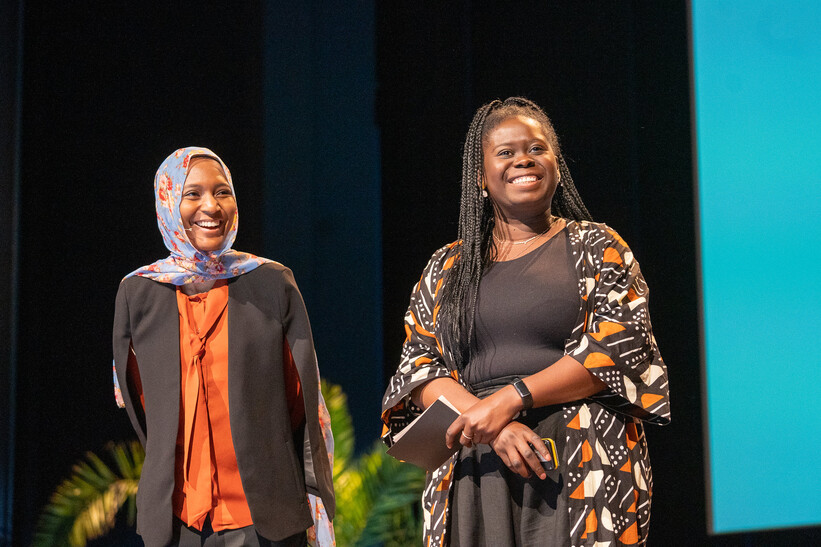
Hadi Touré (left) and Valéry Molay (right) at the 2023 All Systems Connect Symposium - photo by Robert Tjalondo
Call for submissions for the Youth Track of the Africa Water & Sanitation Systems Leadership Symposium 2026 - deadline 30 April.
Published on: 07/04/2026
When I started my career, I was not working in the water sector. I studied banking, finance, and insurance. I spent years in the financial sector before moving into humanitarian action, then governance. It was only when I joined IRC in 2019 that I came face to face with the deep complexity of water and sanitation systems in the Sahel — and I realised something that has shaped my professional conviction ever since: Africa's water crisis will not be solved by water engineers alone.
This August, the Africa Water & Sanitation Systems Leadership Symposium 2026 will convene in Kigali, Rwanda, from 17 to 21 August. Co-convened by the African Ministers' Council on Water (AMCOW) and IRC, this is not another technical conference. It is a political, financial, and institutional space where African leaders and global partners will align behind one shared imperative: building credible, resilient, and investable water and sanitation systems across the continent.
And within this major continental gathering, we are building something unprecedented: a Youth Track designed not for spectators, but for solution providers.
I am honoured to lead this track. Let me explain why it matters — and why it should matter to you, wherever your professional discipline lies.
Working with communities and local authorities in Niger — one of the world's most fragile contexts — has taught me a fundamental lesson. The challenge of delivering safe water is not primarily about pipes and pumps. It is about governance, finance, data, accountability, and the credibility of the institutions responsible for service delivery. When a commune cannot collect tariffs, when a utility cannot account for its water losses, when a regulator has no data on which to base its decisions — these are not engineering failures. They are systems failures.
The symposium in Kigali is built on this premise: that Africa needs to transform its water and sanitation systems, not merely build more infrastructure. That transformation requires a new generation of professionals who can think across disciplines, who understand that a billing system is as vital as a borehole, and that an accountability platform can be as transformative as a treatment plant.
The Youth Track — formally titled African Youth Solutions & Innovation Dialogues — is not a side event or a token panel. It is a structured programme that will select 20 of the most promising youth-led initiatives from across Africa and the diaspora, and place them at the centre of the symposium's agenda.
Here is what makes it different from anything you may have seen before.
First, we are not looking for advocacy. We are looking for operational solutions, robust business models, and technologies ready to scale. The 20 selected initiatives will pitch directly to a panel of institutional decision-makers: government officials, utility directors, regulators, and investors. This is not a competition for prizes. It is a matchmaking platform designed to generate real partnerships and real contracts.
Second, the track is organised around four thematic sessions that mirror the pillars of systemic transformation: technical performance and asset management; commercial performance and service models; circular economy and climate resilience; and data, digital solutions, and accountability. Each session combines structured pitches, intergenerational dialogue with senior experts, and professional speed-dating to forge concrete connections.
Third, and most importantly: we deliberately designed these categories to attract talent from far beyond the traditional water sector.
Let me be clear. If you are a young software developer building real-time monitoring platforms, this track is for you. If you are a fintech entrepreneur working on mobile payment systems that could transform how utilities collect revenue, this track is for you. If you are an environmental scientist developing nature-based solutions for watershed protection, a data scientist using AI to optimise investment planning, a business strategist designing new models for community-based service delivery, or a governance specialist building citizen engagement platforms — this track is for you.
Africa's water and sanitation systems need precisely the diversity of disciplines that our continent's young professionals represent. Non-revenue water reduction demands sensor technology and data analytics. Customer experience improvement requires digital design and behavioural economics. Circular sanitation calls for chemical engineering and supply chain expertise. Regulatory transparency depends on software development and open data architecture. None of these are traditional "water" skills. All of them are essential to transformation.
My own trajectory — from banking and finance to humanitarian action to systems-strengthening work across West Africa — is proof that the most valuable contributions often come from those who bring fresh perspectives to old problems. Innovation does not respect disciplinary boundaries. Neither should we.
The 20 initiatives chosen through our our competitive call for applications (deadline 30 April) will benefit from intensive mentorship and pitch coaching in the months leading up to August. During the symposium itself, each will deliver a 10-minute pitch to decision-makers, participate in speed-dating sessions with potential partners and investors, and contribute to the symposium's closing plenary.
Beyond Kigali, the selected initiatives will be featured in a published compendium of youth solutions, with a clear post-symposium follow-up roadmap. We are laying the foundations for an Innovation Fellowship that will extend support and connectivity well beyond August 2026.
This is about building a pipeline of credible African enterprises that can become trusted partners of governments, utilities, and financiers.
In Niger, I have worked on strengthening WASH services in health centres, where the absence of clean water is not merely an inconvenience but a direct threat to life. I have supported local authorities to develop strategic plans that align their ambitions with realistic financing pathways. I have seen how political commitment at the communal level, when matched with technical support and institutional rigour, can produce genuine change even in the most constrained environments.
But I have also seen something else: a generation of young Africans — entrepreneurs, technologists, researchers, and practitioners — who are ready to do more than inherit the systems we have. They are ready to build the systems we need. What they lack is not talent or ideas. It is access: access to institutional clients, to investors, to the decision-makers who can say yes.
The Youth Track in Kigali is designed to provide exactly that access.
We are calling on young professionals and entrepreneurs aged 18 to 35, based in Africa or from the diaspora, to submit their initiatives before 30 April. Whether you work in technology, finance, environmental science, governance, engineering, data science, or business development — if your solution can strengthen the operational credibility and institutional performance of water and sanitation systems, we want to hear from you.
The deadline of 30 April is approaching. The opportunity is real. And the continent is watching.
Africa's water transformation will not be achieved by any single discipline. It will be achieved by a generation that refuses to work in silos — a generation that understands that systems are built by people who think across boundaries.
Be part of that generation. Join us in Kigali.
---
For submission details and eligibility criteria, visit the Africa Water & Sanitation Systems Leadership Symposium 2026 website https://www.africawatersystems.org/submissions
Ismaël Ousmane is Country Coordinator of IRC Niger and leads the Youth Track of the Africa Water & Sanitation Systems Leadership Symposium 2026. His background spans banking and finance, humanitarian action, and governance. At IRC, he works in partnership with local and central authorities to build and strengthen water and sanitation systems in one of the world's most challenging operational contexts.
At IRC we have strong opinions and we value honest and frank discussion, so you won't be surprised to hear that not all the opinions on this site represent our official policy.