Do they work?
Published on: 08/10/2024
The One For All alliance curates a small informal group that discusses selected topics on finance in water and sanitation. This monthly blog series attempts to share our reflections and thinking with a wider audience.
A finance strategy is a strategic document showing the finance gap in a country and providing options to guide decisions about investments and changes in water and sanitation by governments. It aims to ensure the financial sustainability of services and recommends policy measures to close the finance gap. It's also an important opportunity to identify ways, through critical stakeholder engagement, how to make better use of existing funds, how to reach those that don't have services and how to attract new investments to the sector.
Finance strategies provide a common language, framework and great in-depth financial data to talk about money in a sector that keeps asking for this while showing limited progress.
We sometimes see Excel sheets that show financial projections for different water and sanitation target scenarios being called finance strategies. While data analysis is an important part of a finance strategy, it is not enough. Without the engagement of Ministries of Water, Sanitation and Finance (at a minimum) and discussions with key donors, service providers and civil society, those Excel sheets cannot be called "a strategy".
Too often, WASH sector investment decisions are made piecemeal rather than according to a coherent long-term plan. Investments tend to be project-based, not service-area based. This increases the likelihood that people not impacted by a particular project are left behind if a broader strategy is not in place.
The Sanitation and Water for All partnership has 5 principles for sustainable finance in the sector. Principle 2 focuses on the need for "WASH finance to be coordinated through integrated finance strategies that align with national and international commitments and priorities". Many governments still invest in the sector project by project; it is therefore no surprise that finance institutions and donors also focus on traditional investments that focus almost exclusively on infrastructure. This approach leads to structural and systematic failures since it ignores the complementary finance needed to ensure functionality and efficiency in the management of water services and also risks replicated investments several years later when the infrastructure breaks down – the exact opposite of using scarce funds more efficiently.
The development of finance strategies needs very clear (national) sector leadership. To support the process and development of water and sanitation finance strategies UNICEF published the guide "How to develop a water, sanitation and hygiene finance strategy in 2022. (Available in English, French and Spanish)
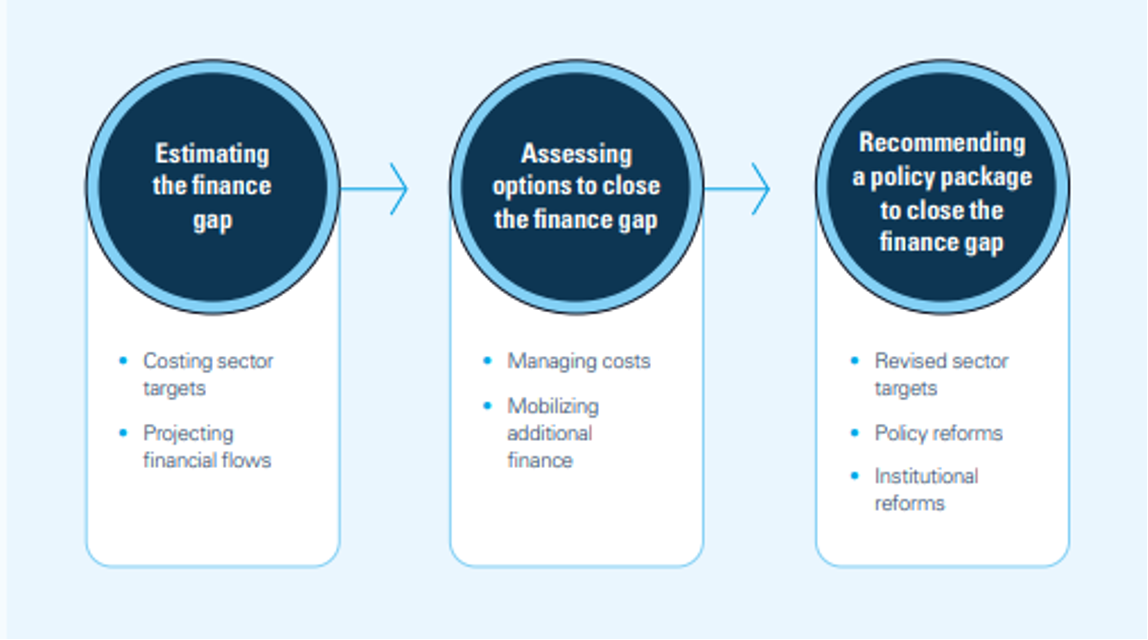
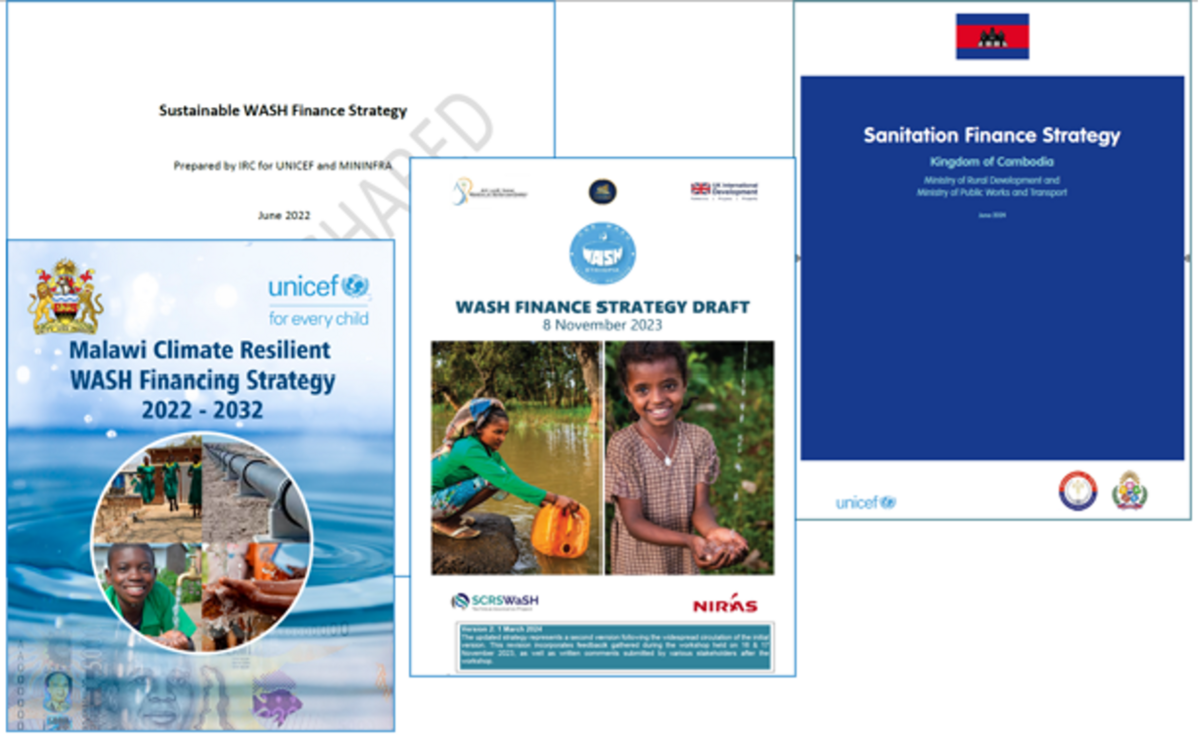
Many countries have developed water and sanitation finance strategies following this guideline or a similar approach. They vary widely in scope. IRC has supported some strategies which are quite broad and include solid waste and flood protection (Rwanda), others more focused on sanitation only (Cambodia), some with limited secondary financial data (Malawi and Honduras), others with extensive primary data collection (Ethiopia). Some strategies start looking at climate resilient options and their costs, but not all. We know that Zimbabwe and Uganda have also recently developed strategies and Tanzania is in the process of completing one.
From IRC's experience in supporting the development of finance strategies what has worked well is to have cross-ministerial and departmental conversations that don't happen frequently in a fragmented sector. For instance, bringing together departments responsible for urban water in cities with Ministries of Infrastructure, Water and Finance. It's a relatively simple process to train local and regional consultants and local partners to support and drive the data collection, interviews and analysis in country. We have found it works equally well to train finance experts in the water sector as it does, to train water sector colleagues to work with finance. In all the finance strategies there were requests halfway the process to provide tailor made training on finance to public sector colleagues – and this was easily accommodated. A strategy employed in an initiative led by the Global Water Partnership (GWP) was to hire a local finance consultant to lead the finance planning process across water sector experts, thus building their familiarity and comfort with the workstream.
Throughout the development of the finance strategies, discussions led to changes that were acted upon before the completion of the strategy. For instance: a formal request for budget lines and codes for sanitation, the set-up of working groups on tariffs, or acting on non-revenue water.
In countries that don't get cheap finance through national governments, the strategy development process also surfaced the opportunities available through national public development banks - a funding source that had so far not been part of the financial discussions in the sector.
Across the countries where IRC supported this development, it took a minimum of six months to get the basics on how much money is flowing to the sector. This usually involves going line by line through the country national budget in a PDF document and interviewing a lot of service providers. Some critical blockages in accessing financial data for urban areas led to questions of transparency and integrity that need to be investigated further.
It's easier to collect the data when previous finance intensive exercises such as WASH Accounts have been done and/or where there are budget briefs. WASH Accounts are an international accounting framework for systematically tracking WASH-related spending. It was developed by the World Health Organization (WHO), inspired by the System of Health Accounts used by countries around the world.
Collecting data at city or municipal level, where funds often flow through larger utilities, is a bigger struggle usually than you would expect. Similarly, getting important insights from household contributions, either in the form of self-supply (own investment in sanitation for instance) or through tariffs paid to utilities needs to be done through a representative sample.
While the process of developing finance strategies typically brings different initiatives together in water, sanitation and education and health departments, it's usually much harder to bring together the colleagues working on drinking water with those working on water resources management (and we don't have an explanation for this). We also became cognizant that sometimes government actors have incentives for the duplication, rather than the alignment of initiatives.
At the top of the list of possible options to get more money for the sector are always reforming tariffs and improving efficiency. When the charge per cubic meter to consumers is much, much lower than the production cost and has not been revised in 10 years, it's obvious that something needs to be done. This failure to update tariffs over an extended period of time also perpetuates bad targeting of subsidies for people with piped water in cities. Similarly, when non-revenue water (water that is lost largely to leakage) reaches 70%, it is clear that investment in maintenance is critical. Some level of non-revenue water is normal, but who is willing to lose 70% of an investment from the onset?
The other pattern observed is that sanitation is really underfunded, underplanned and undertargeted. Most of the existing investments go to urban sanitation in the form of wastewater treatment plants. It's also a sub-sector where there are good policies, but they are poorly implemented.
All the countries seem to struggle with access to climate funds, presumably because water sector colleagues are not involved in the national climate discussions and also because of complex processes at country level to articulate the demand (see previous blog on this).
Strategies have led to higher budget allocations and to additional funding and initiatives in some of the countries. The options laid out in the finance strategies typically provide something for everyone. Different stakeholders working in different areas of the sector can pick and choose those over which they have influence and take action with better evidence and justification.
There is always a risk that when there is a government change, a new government will not remain committed to the finance strategy. It's important that the strategy remains a live document shared and known by many within and outside the sector and connected to higher level initiatives.
Rather than replicate work already done, the process of developing finance strategies builds upon and unites fragmented and different existing initiatives. It helps to frame or provide a policy backup to what exists already. But that also means that even if the original contracts for developing the strategies have a timeframe of six months, coordinating and aligning with existing initiatives may extend the process – IRC experience is that they take more than a year to complete. It takes a long time to get everyone on board. There are internal interests in place for things not to change, for data not to be shared. Ministries and their departments are not uniform and therefore the process needs good facilitation by local teams.
Finally, besides urging more countries to develop and implement finance strategies, there's a big opportunity for replicating this process at more localized level, where there's even less financial data and less discussions on options to mobilise funds.
For an introduction to finance strategies in the sector see Session 5 of Introducing finance for sustainable water, sanitation and hygiene systems available on the WASH Systems Academy and UNICEF's Agora.
At IRC we have strong opinions and we value honest and frank discussion, so you won't be surprised to hear that not all the opinions on this site represent our official policy.