The importance – or dependency – on aid in the water and sanitation sector
Published on: 23/06/2025
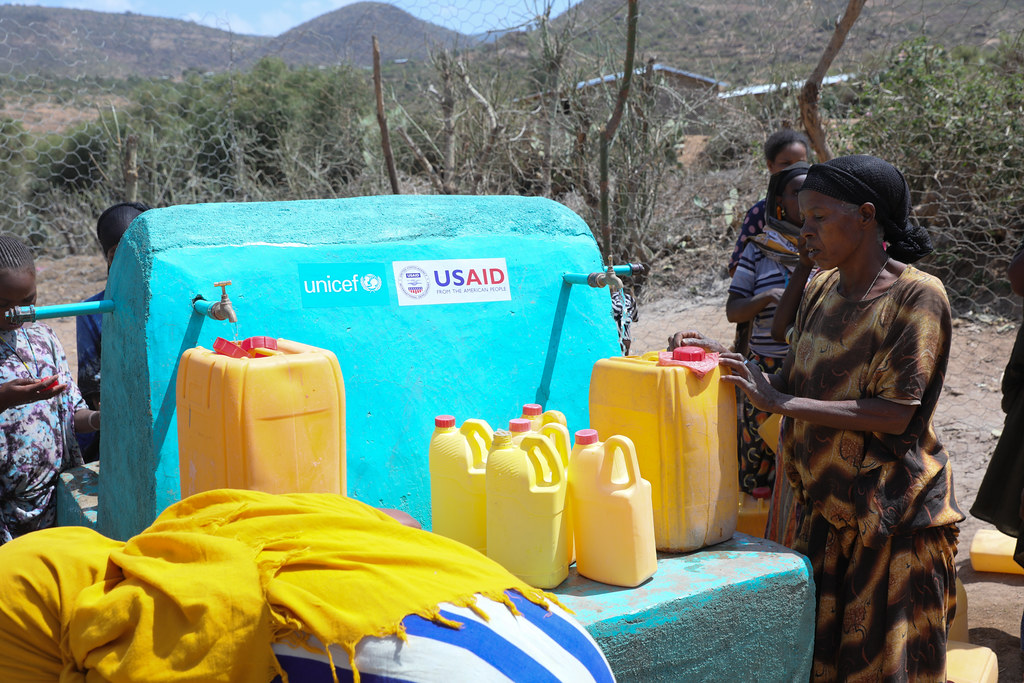
©UNICEF Ethiopia/2022/Nahom Tesfaye
Given the impact of the recent cuts to U.S. aid, we wanted to explore the broader question of how dependent the water and sanitation sector is on international aid, and particularly on aid from the U.S. Based on this, we wanted to reflect on the implications for countries' ability to finance water and sanitation services in a sustainable manner.
This blog summarises a discussion amongst the finance innovation group of the One For All alliance and other WASH finance friends and is part of a series of blogs on the topic of financing WASH.
By Stef Smits and Catarina Fonseca
We started our exploration by looking at countries’ overall dependency on aid, and the relative size of water and sanitation in that. The graph below plots the importance - or dependency – of aid (Official Development Assistance – ODA), expressed as ODA as a percentage of gross national income (GNI), and the percentage of ODA going to water and sanitation in those countries, using data reported through OECD’s Creditor Reporting System.
The red square shows the interquartile range of low-income countries, the blue square the interquartile range of lower-middle income ranges, and the yellow square the interquartile range of upper-middle income countries.
Figure: Relative size of ODA, and of ODA to water and sanitation
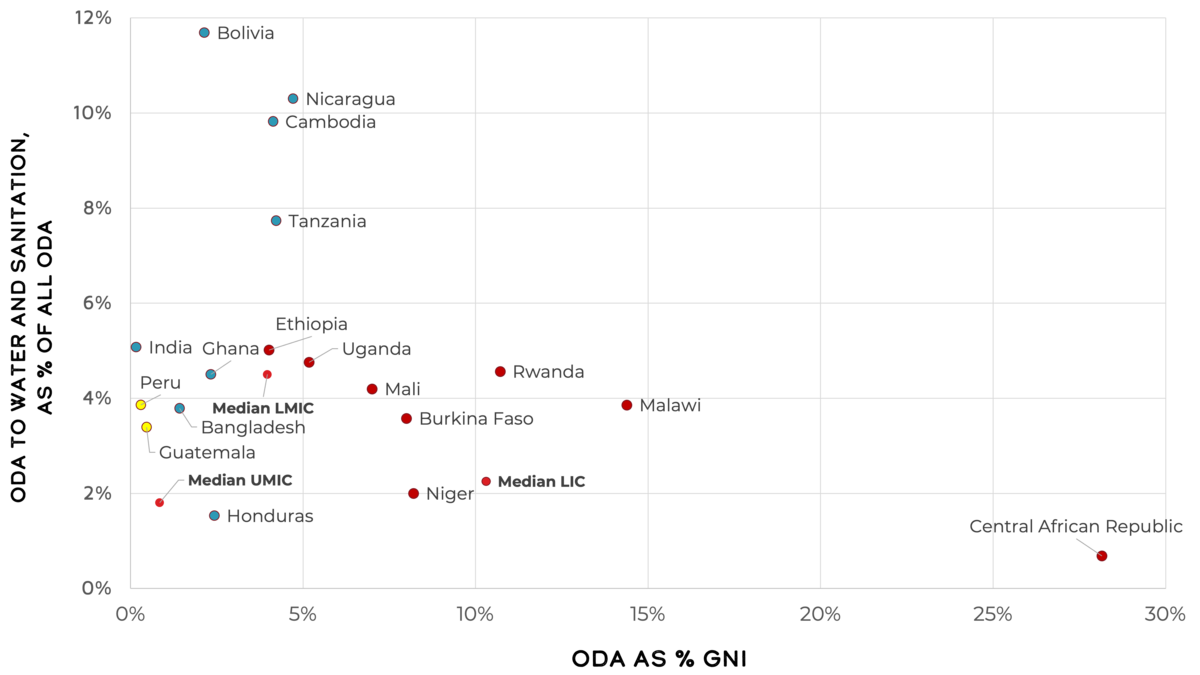
The low-income countries (red) have a higher dependency on aid, but spend a relatively small percentage of aid on water and sanitation. There are many other competing needs, and ODA is spent across many sectors. Moreover, these include some of the most fragile and conflict-affected states (e.g. South Sudan, Central African Republic, Afghanistan), who spend more ODA on emergency and humanitarian aid. These countries are thus very vulnerable to shocks to the aid system – but water and sanitation is only one of many sectors affected.
The lower middle-income countries (blue) depend less on aid, but some allocate significant percentages of their aid to the water and sanitation sector. In this group, there are also outliers - countries spending more than 10% of all their ODA on water and sanitation, such as Nicaragua and Tanzania. The water and sanitation sectors in these countries are very vulnerable to sharp decreases in ODA.
The group of upper middle-income countries (yellow) shows that they depend less on ODA and spend relatively small percentages of that aid on water and sanitation. These countries should be able to absorb shocks to the aid system through their own domestic resources.
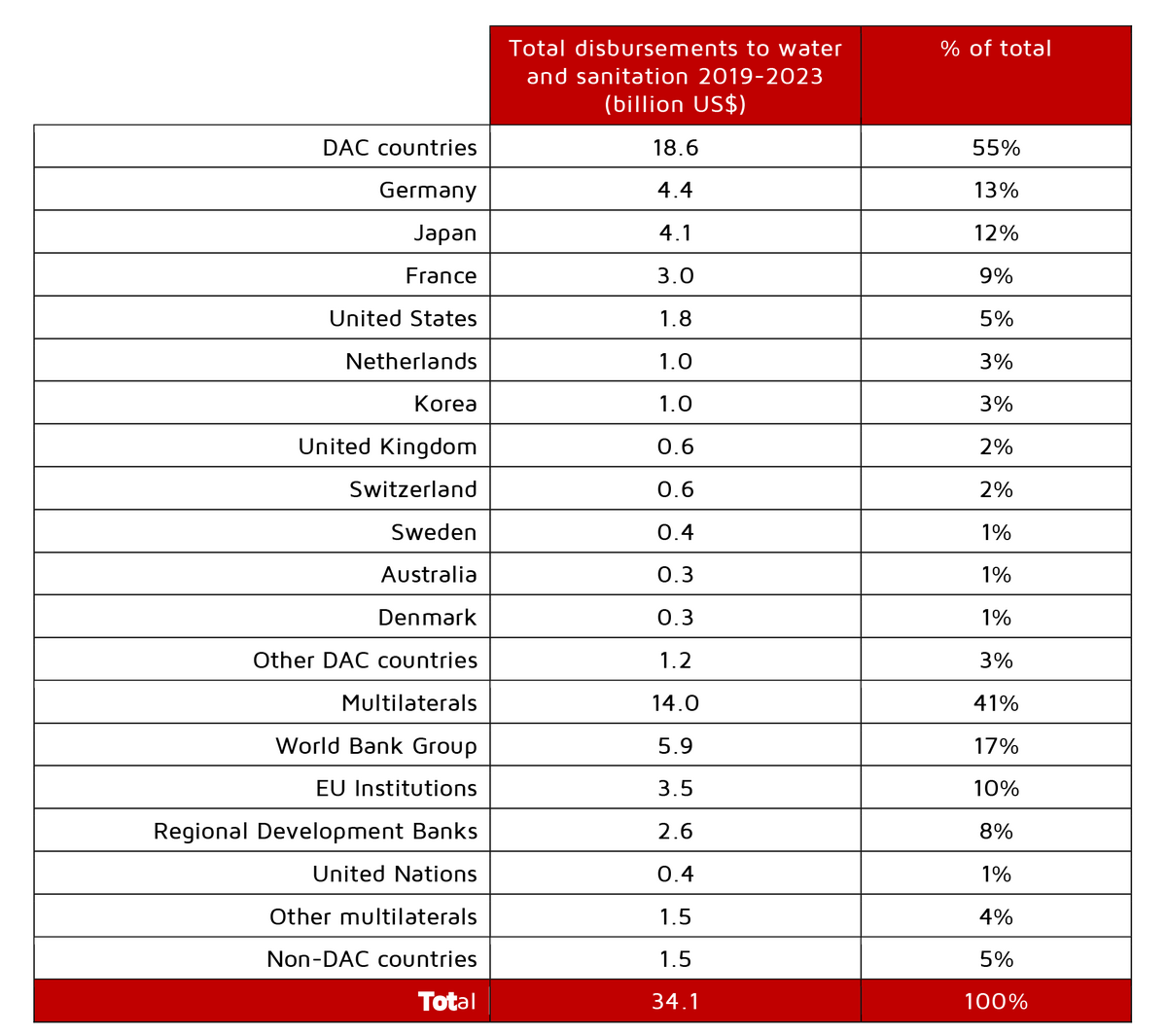
It is widely acknowledged that the U.S. has been a systemic player in global aid. Over the period 2019-2023 the U.S. provided 1.8 billion US$ of ODA to water and sanitation, this being 5% of all ODA to the sector (see the Table below). It made the U.S. the fourth largest bilateral donor to the sector after Germany, Japan and France.
With these amounts of money, the overall vulnerability of the water and sanitation sector to U.S. aid is not as high as in other sectors. However, the exposure of individual countries tells a different story. There were three countries where the US provided more than 70% of all ODA to water and sanitation: Afghanistan, Liberia and Mongolia. Countries that are highly dependent on aid but where the USA provided less than 10% of all ODA to water and sanitation, include Rwanda, Malawi, Palestine, Mozambique, South Sudan and Yemen. These may have some scope for other providers of ODA to step in, but less ability to deploy domestic resources.
However, what many of us appreciated was that U.S. aid has funded projects and programmes over the past years that sought to bring about systemic and catalytic change. It funded projects focused on creating markets for the provision of water and sanitation services; supporting financial intermediaries between service providers and financial institutions, and global knowledge sharing and thought leadership. In these areas, it does leave a gap.
Table 1 main bilateral and multilateral donors to water and sanitation over the period 2019-2023. Source: OECD Creditor Reporting System data explorer
The analysis above is very rough and based on numbers alone. One of the areas that is difficult to assess is that, over the years, aid has increasingly played a much more catalytic role. While some bilateral and multilateral investments are still very much focused on infrastructure, now some of the aid comes in the form of guarantees, seed or revolving funds, which often attract further investments from private and public sectors.
There has also been an overall increase in concessional loans provided by both multilateral and bilateral donors. However, the replacement of grants by loans alone could risk leaving the most vulnerable regions behind, as these areas often lack attractive or bankable projects for investment.
The U.S. aid termination was a wake-up call to an area of risk which is usually not considered in finance discussions in the sector. Although the low-income countries are highly dependent on aid, they tend to spend a relatively small percentage of that on water and sanitation, and the sector is therefore just as vulnerable to change as any other sector. Countries with a relatively higher exposure risk to aid fluctuations are lower middle-income countries, particularly those where aid has been heavily focused on water and sanitation.
Participants agreed that the shock of decreased U.S. aid has also prompted some countries to explore the possibilities of domestic resource mobilisation and to return to basics: increasing efficiency in water utilities, raising tariffs where appropriate, and improving cost recovery mechanisms. These will be essential steps towards reducing dependency on aid. There was also a call to action for more targeted aid interventions in regions where international aid was still necessary.
At IRC we have strong opinions and we value honest and frank discussion, so you won't be surprised to hear that not all the opinions on this site represent our official policy.