


Breaking the cycle of contamination
Revisiting the myths around safely managed sanitation
Published on: 11/11/2024
By Andy Narracott and Digbijoy Dey
In a blog published on July 22 on the Susana platform, Andy Narracott discussed five misconceptions surrounding safely managed sanitation. In this post, along with Digbijoy Dey, we will elaborate on two of these misconceptions. Addressing these misconceptions opens up opportunities to transform challenges into viable solutions.
In many rural regions, it might be easier to upgrade the service to safely managed sanitation. The goal of safely managed sanitation is to halt the spread of faecal pathogens, and even simple pit latrines can achieve this effectively in the right context. When we think about safely managed sanitation, we often visualise the entire sanitation service chain.
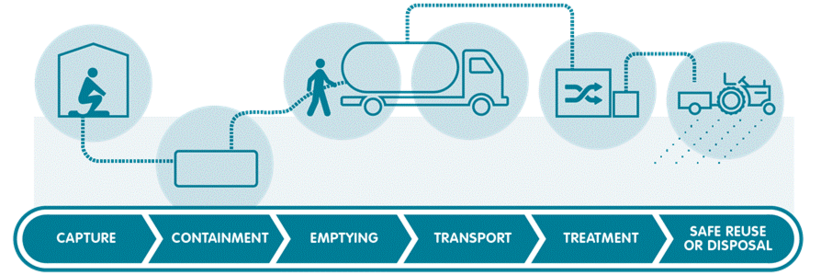
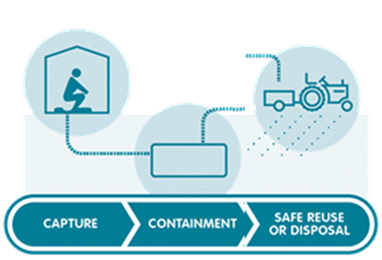
However, we sometimes overlook the fact that not all these service steps are necessary in every context. A contextualised service can be designed using the Sanitation Safety Planning tool, and depending on the identified risks, can be significantly simplified. For example, if there is a low risk of latrines polluting groundwater that is used for drinking, local authorities can permit the use of simple double-pit offset latrines, which can be an excellent option for rural areas. These latrines can be emptied after degrading for at least two years and the resulting pit humus re-used in agriculture, eliminating the need for transportation and off-site treatment, and reducing the risk to sanitation workers and the surrounding community from emptying practices. Similarly, options like composting toilets or urine-diversion dry toilets can also provide a relatively safe level of sanitation service if appropriate for the context (e.g. high capacity of users to adopt safe behaviours and a local authority to continually educate the public and enforce standards).
With careful assessment, service planners can promote these solutions, which are already being successfully used in places like Sweden and Germany, and they can be adapted for many rural areas. Additionally, container-based sanitation is gaining popularity in various countries and holds potential for plugging gaps in safe sanitation service options in urban environments. In densely populated places like Nairobi or Mumbai, container-based sanitation can perform well. Discerning the best solution for each context needs to be the responsibility of local authorities. Tools like Sanitation Safety Planning can help in this regard, ensuring unsafe practices are phased out and public health is protected.
The notion that safely managed sanitation is too expensive, particularly in rural areas, may not hold true. There are several reasons for this. As mentioned earlier, the potential to simplify the sanitation service chain is greater in rural settings, which reduces investment requirements. Furthermore, faecal sludge treatment plants in urban areas often struggle to find markets for their end products (e.g., soil enhancers and liquid fertilizers for agriculture, or briquettes for domestic fuel) due to proximity issues. In contrast, rural areas often have nearby consumers ready for organic products. Rural China, especially in Sichuan and Yunnan, often uses dry toilets, with the sludge dried and turned into compost. Using small biodigesters, faecal sludge from regular latrines is also used to produce biogas for fuel, while the remaining digestate serves as a soil conditioner. As stated before, contextualisation of the service is important, if the treatment process is selected considering local practice and demand, it can lead to a viable service.
Moreover, a comprehensive sanitation service—which includes capture, containment, emptying, transport, treatment, and reuse or disposal—requires substantial investment, particularly institutional investment. On the other hand, simplified services can leverage alternative funding sources. For example, many households in rural Bangladesh use microfinance to construct their latrines. Microfinance institutions not only provide funding but also connect households with private service providers to build contextually appropriate technologies informed by local risk assessments, such as double-pit offset latrines.
This discussion is not intended to oversimplify the challenges associated with achieving safely managed sanitation. These challenges are real, and there is no one-size-fits-all solution. However, local-level planning and contextualization of services can alleviate many obstacles, and in some cases, turn challenges into opportunities.
At IRC we have strong opinions and we value honest and frank discussion, so you won't be surprised to hear that not all the opinions on this site represent our official policy.