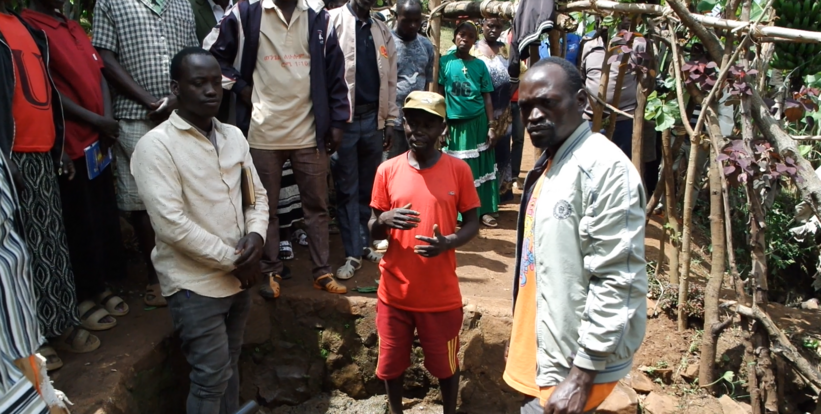
Learning exchange in action Photo by Nebiyu Gashawbeza
The best experience from Shishir Kebele demonstrates how kebele-level internal learning exchange, embedded within formal governance structures, can significantly improve WASH service delivery and community ownership.
Published on: 27/02/2026
Sustainable water, sanitation and hygiene (WASH) services require more than infrastructure; they rely on robust local leadership, shared learning, and continuous reflection at the kebele level, the lowest governance level. Internal learning exchanges on water service delivery within South Ari Woreda’s kebele allow communities to identify what works, correct what does not, and scale good practices using their own capacity and resources.
The best experience from Shishir Kebele demonstrates how kebele-level internal learning exchange, embedded within formal governance structures, can significantly improve WASH service delivery and community ownership.
Across many kebeles in South Ari Woreda, health and education sectors come together and regularly present their plans and performance reports to the Kebele Council. This practice helps align the two sectors' activities with kebele priorities and strengthens accountability.
Water service delivery, however, has been following a different route. In most kebeles, water-related issues are discussed and reported directly to the Woreda through the Kebele WASH Committees Federation, with limited engagement of the Kebele Council. While administratively functional, this approach has weakened Kebele ownership of water services, limited alignment with other sectors and reduced opportunities for internal reflection and learning exchange.
Shishir Kebele intentionally adopted a different approach. The Kebele integrated water-related agendas into the Kebele Council’s regular meetings, alongside other social services. This ensured that water service delivery became a shared development agenda, rather than a technical issue managed by a few actors.
This practice gained momentum during the implementation of the Water Safety Plan (WSP). The WSP team members, kebele leaders and community representatives worked closely, supported by continuous awareness creation from the South Ari Woreda Water Office, particularly through woreda learning alliance meetings. Over time, Shishir Kebele developed a culture of internal learning exchange through dialogue, field visit reflection, and joint decision-making.
A recent Kebele Council meeting in Shishir Kebele focused on three critical WASH issues, including household latrine utilisation, access to safe and reliable water services for villages not served, and water scheme management /governance.
Rather than ending with discussions alone, the Kebele Council members, under the leadership of the Kebele Council Speaker, decided to translate discussions into practice-based learning. A field visit and experience-sharing session was organised to observe water facilities constructed through community-led initiatives.
During the field visit, representatives from water associations in different villages met with the Kebele Council members at the water points. They explained the full journey of water scheme construction and WSP implementation, including awareness creation and community mobilisation, community contribution and collection (cash, materials, and labor), construction processes and local problem-solving and establishing a water governance system for newly built water schemes.
This learning exchange allowed council members to learn directly from the community, strengthening mutual understanding and trust.
This interaction transformed the routine reporting into collective learning, rooted in real-world experiences.
As a result of this kebele-level learning, water scheme coverage per village increased from 45% to 75% and 12 out of 16 villages now have functional water facilities. During the post-visit reflection, Kebele Council members recognised that the progress achieved was not driven by external funding alone, but by strong community engagement and collaboration, learning exchange among villages, and mutual accountability. The Council formally resolved to sustain this approach and promote it across the remaining villages.
Internal learning exchange continues to shape action in Shishir Kebele. The remaining four villages have already started collecting community contributions, identified potential water sources and mobilised locally available construction materials. According to the Kebele Federation Chairperson, once sufficient funds are secured, construction will begin, demonstrating growing community confidence and reduced dependency on external support.
Community perceptions of water contamination can drive accountability and action. During the learning exchange one community member joked, “እንት ኖቃ ኡስኪዶቅዶ ፋንቃ ጎብድን ወጪ ዳዮ” “You see, don’t you? You are drinking water where frogs jump around.” Another quickly responded, “I will soon construct a better water facility and show it to you."
The experience of Shishir Kebele highlights several lessons relevant to sustainable WASH systems. First it demonstrated the value of kebele-level learning exchange platforms, spaces where communities can reflect together, strengthen ownership and reinforce accountability. Integrating water agendas into Kebele Council meetings further deepens this ownership , ensuring that water management becomes part of routine governance rather than an isolated activity.
The experience also showed that learning is most effective when it is practical. Field visits, where people observe challenges and solutions firsthand, prove far more impactful than written reports alone. The WSP emerged as both a technical and a social process, creating shared space for learning, dialogue, and collective action.
Finally, Shishir demonstrated that community‑led initiatives scale more quickly when learning is shared internally. Visible success, whether a functioning water point or an improved practice, motivates others to act, creating momentum that spreads across villages and accelerates change.
At IRC we have strong opinions and we value honest and frank discussion, so you won't be surprised to hear that not all the opinions on this site represent our official policy.