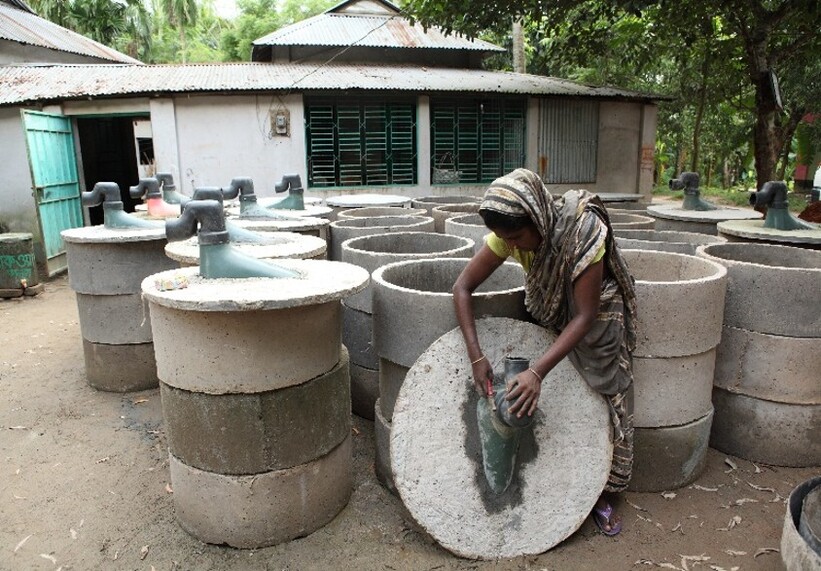
Extreme weather events in Bangladesh damage water and sanitation facilities. Developing sustainable delivery models is therefore essential.
Published on: 20/02/2025
Like other deltaic geographies, Bangladesh faces substantial risks from regular episodes of a range of natural disasters including flooding, riverbank erosion, sea level rise, salinity intrusion, tidal surge, cyclones and waterlogging. Additionally, it faces vulnerability due to dry season water shortages and wet season water surpluses, and from being a lower riparian state. These extreme climate events reduce the lifespan of WASH facilities.
In November 2022, IRC started a new partnership with BRAC, the largest non-governmental development organisation in the world, for the Embassy of the Kingdom of the Netherlands’ funded project 'Equitable and Sustainable WASH Services in Bangladesh Delta Plan Hotspots 2022-2026'. The project aims to develop a sustainable model for WASH services in the climate hotspots of Bangladesh. The project is working in 4 delta plan hotspots (coastal areas, drought-prone areas, floodplains and low-lying river basin areas) across 14 districts of Bangladesh. The project will address three key objectives:
With these interventions, the project aims to reach 1 million people with safely managed water and sanitation (basic minimum) services. As the knowledge and innovation partner of the project, IRC is working towards documenting and disseminating the knowledge generated during the course of the project, starting with the first project brief and the first technical paper. The first project brief provides the project overview, and analyses the project baseline data identifying the weakest points in drinking water and sanitation service delivery in the four climate hotspots, and indicates where innovations can enhance these services in the future.
The first technical paper provides a semi-qualitative assessment of the available drinking water and sanitation service delivery models in the climate hotspots. The objective is to critically identify areas for strengthening water and sanitation service models within the scope of the project. Beyond technology, the technical paper examines the operational aspects of the service delivery models (e.g., finance, infrastructure management, environmental suitability, etc.).