


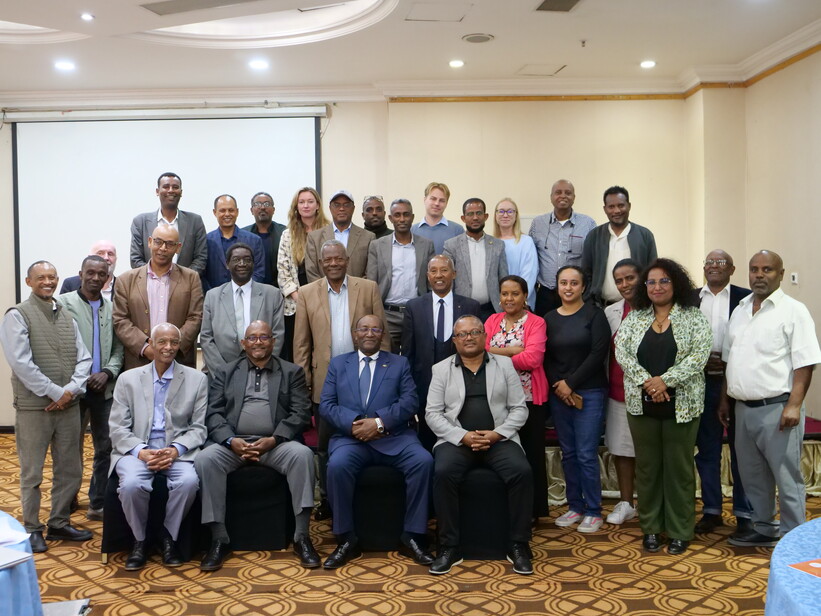
Participants of the workshop
Ethiopia is gathering input for a roadmap for the Presidential Compact on WASH.
Published on: 22/10/2025
IRC WASH, in collaboration with the One WASH National Programme (OWNP) and the Ministry of Water and Energy (MoWE), organised a one-day workshop on the WASH Presidential Compact and Sanitation and Water for All (SWA) country commitments in Addis Ababa on October 10, 2025.
The workshop brought together high-level government officials, including the State Minister, H.E. Ambassador Asfaw Dingamo (PhD), as well as representatives from the Embassies of Denmark and the Netherlands, development partners, multilateral organisations (UNICEF, World Bank), and the private sector.
The objective of the workshop was to consult and get additional inputs for the national roadmap for the WASH Presidential Compact, review progress on Ethiopia’s current SWA country commitments, and formulate new commitments.
In his opening remarks, H.E. Ambassador Asfaw Dingamo (PhD) emphasised that achieving universal access to water, sanitation, and hygiene (WASH) is not only a development priority but also a moral obligation and a fundamental human right. He noted that every citizen deserves access to these essential services, which are critical to dignity, health, and prosperity. To realise this vision, he called for renewed collective determination, stronger partnerships, and continued efforts to translate political will into concrete action.
According to Kevin Roussel, SWA’s Regional Coordinator for Africa, the Heads of State Initiatives (HoSI) are supported by a network of global and national SWA partners that coordinate joint advocacy efforts and provide technical assistance. These partners work to make presidents and prime ministers commit to achieving universal access to water, sanitation, and hygiene, and to make it a priority within their mandates.
The realisation of a WASH presidential compact involves four phases, which include triggering a country's interest towards developing a compact, confirmed by a Minister or other politically appointed leader, followed by the incubation of the compact preparation, signing, launching, linking with existing country initiatives and platforms, and finally, delivering and following up on the implementation of commitments, and an evaluation stage to track progress.
In Africa, 16 countries are actively engaged in the Heads of State Initiatives so far. Among them, three countries (Nigeria, South Sudan, and Ghana) have active compacts, two countries (Nigeria and Liberia) are developing updated compacts, and four countries, such as Ethiopia, Zimbabwe, Burundi, and Malawi, are in the process of developing their own compacts.
The compact provides an opportunity to attract additional investments for improving water, sanitation, and hygiene services. In Africa, it has helped mobilise around three billion USD annually, which represents a significant amount of funding.
Ethiopia’s status as the only African country to have hosted the first high-level SWA Ministerial Meeting in 2016, as Kevin added, demonstrates the country’s strong commitment to advancing WASH goals and commitments.
The Senior Advisor to the Minister of the Ministry of Water and Energy, Abera Endeshaw, presented the roadmap for the WASH presidential compact in Ethiopia. He mentioned that the MoWE has been leading the development of the roadmap with the support of the Minister. He also underscored the importance of HoSI to expedite the national and global commitments, to apply an integrated approach for WASH service improvements, and as a high-level advocacy tool for the broader national WASH programme.
The compact will focus on a few high-level and strategic issues and will be concise.
The development of the Presidential Compact Roadmap involved a small group consultation, continuous engagement and technical assistance from the SWA Secretariat, a desk review of relevant documents and experiences of other countries, internal consultations among OWNP, MoWE, and IRC WASH, preparation of the Terms of Reference, formulation of guiding questions, and stakeholder key informant interviews.
Key focus areas of the Compact are finance (increase sector finance and efficient utilisation of existing resources), mutual accountability, and knowledge management.
According to Abera, the triggering stage has been completed, and Ethiopia is now in the incubation stage, which involves the development and finalisation of the compact. Once the draft compact is ready, it will be shared with the wider sector and other stakeholders for feedback before proceeding to the commitment /signing stage.
After Abera’s presentation, participants emphasised the need for a strong commitment to sign and implement the compact. They also highlighted the importance of incorporating sustainability, private sector engagement, and collaboration with academic institutions.
Abiy Girma, the Coordinator of the One WASH National Coordination Office (NWCO), gave a presentation on Ethiopia's existing SWA commitments. The current commitments of Ethiopia under SWA include eliminating open defecation, climate-resilient WASH services, strengthening WASH in schools and health facilities, enhancing private sector engagement, and increasing WASH financing.
Based on the SWA commitments, and by harmonising budgeting and reporting through OWNP, Ethiopia has achieved a significant increase in public finance for WASH (the consolidated WASH account serving as a pooled financing mechanism between government and development partners), progress in increasing access to safe water and basic sanitation, a significant decline in open defecation, and the introduction and scale-up of market-based sanitation.
Participants emphasised the need to quantify the achievements to date and present them with clear timelines. They also suggested recognising the involvement of the private sector in the WASH sector and the development of the WASH financing strategy as key achievements.
For the coming years, Ethiopia’s SWA commitment will focus on endorsing and implementing the national WASH financing strategy, expanding climate-resilient WASH services, enhancing monitoring and accountability, promoting inclusive WASH services, and strengthening institutional capacity.
Finally, the participants evaluated the implementation of the country’s SWA commitments using a tool provided by SWA, and the results of this assessment to be presented at the SWA Ministerial Meeting taking place in Spain on 22-23 October 2025.
