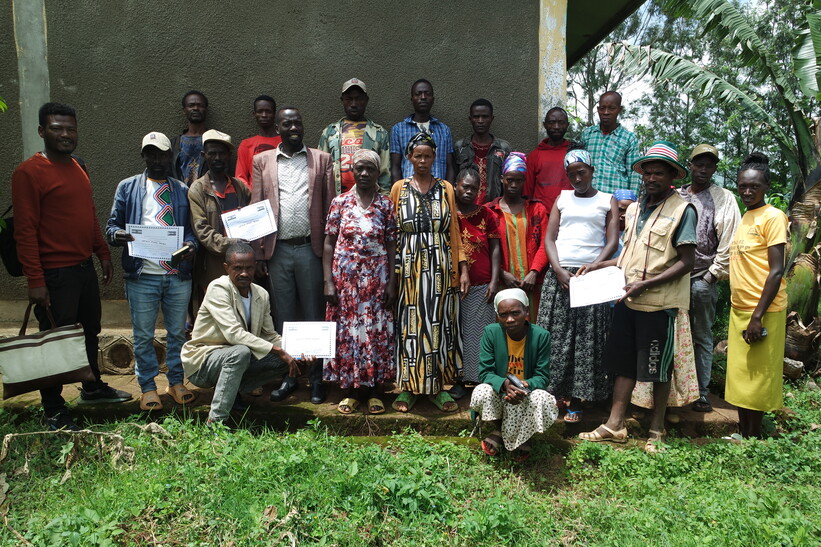
Mukelet Water User Association is celebrating its official status as a legal WUA Photo by Nebiyu Gashawbeza
Published on: 17/06/2025
In an effort to strengthen the sustainability and accountability of rural water services, the South Ari Woreda Water, Mine, and Energy Office, in partnership with IRC WASH, has successfully legalised 50 new Water, Sanitation, and Hygiene Committees (WASHCOs) as Water Users Associations (WUAs) and revived 39 existing WUAs. The legalisation process has been based on the Regional Rural Water Scheme Management Guideline (201/2004). The 39 existing WUAs were first legalised eight years ago and had not been active. Now, they are returning to active water scheme governance.
This renewed effort builds on the foundation laid in 2008 E.C., when 57 WUAs and 14 federations were established and legally certified with support from the Regional Water Bureau. With this latest expansion, South Ari Woreda now has a total of 119 legalised WUAs and 24 WUA federations across 26 kebeles, each of them received water scheme management and operation capacity building training delivered by Woreda-trained trainers.
The training sessions are practical, kebele-specific, and have been conducted at the scheme level, focusing on legal responsibilities, financial management, routine maintenance, and community leadership. These capacity-building efforts are designed to address long-standing gaps in WASH governance within the woreda.
According to Hailu Dermi, Chairperson of the Shishir kebele WUA Federation, there has been a lack of refresher training, and many members were not able to read or write; as a result, most of the committee members had forgotten the guidelines. But moving forward, they will manage their water scheme in accordance with the guidelines to ensure sustainable service provision.
Woreda leadership emphasised that community ownership is the foundation of sustainable water service. South Ari Woreda Administrator Gizaw Haile delivered a compelling message:
“We hear everyone saying, ‘Water is Life,’ but most of us do not act on what it requires to make water life. Our community is suffering deeply due to the lack of access to clean water. During a recent discussion, one of our leaders reflected on the story of Hagar, the second wife of Abraham, as told in the Holy Scriptures. After being sent into the desert with her son Ishmael, she ran out of water and, in despair, placed her son under a bush and cried out. In response to her suffering, God heard her and opened her eyes to see a nearby well of water. Her salvation was close, though she could not see it at first.
In many ways, our situation mirrors that of Hagar. We are thirsty, desperate, and in need. Yet, like Hagar, we have precious water sources near us that could save lives and sustain our communities. However, instead of recognising and acting upon what is already within reach, we continue to wait for external actors to construct and maintain the water schemes. The lesson is clear: we must open our eyes, recognise the resources around us, and take local initiative to ensure water access for all.”
The presence of the Woreda Administrator and the Prosperity Party leaders in several kebeles have demonstrated strong political commitment to community-based WASH governance. Their involvement has inspired kebele-level leaders and communities to take the water management agenda seriously.
In most kebeles, local leaders have taken responsibility for facilitating the establishment of WUA Federation offices and ensuring that water scheme management is formally included on the agenda at the kebele level.
This initiative is a key part of South Ari Woreda’s broader effort to implement its WASH SDG Master Plan, aiming for universal and sustainable access to safe water and sanitation by 2030. Through legalisation, capacity building training, political engagement, and strengthened accountability, the woreda is laying a strong foundation for long-lasting, community-driven water services using community resources. The federations will report to the Woreda Water Office on a monthly basis, and the kebele leaders will engage in regular discussions with the federations to address any challenges encountered during implementation. The woreda still has 31 WASHCOs that need to be legalised and upgraded to WUAs and has plans to achieve this shortly.