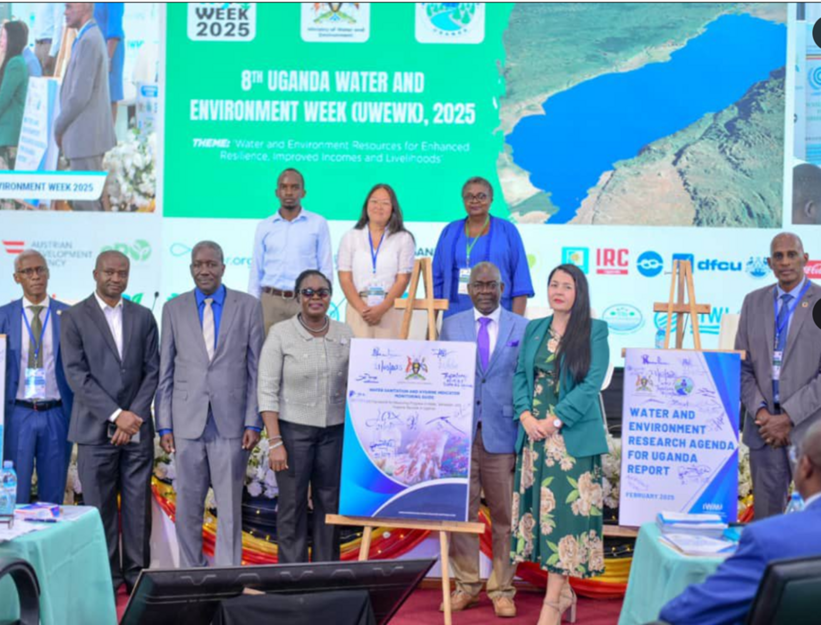
Hon Minister Nankabirwa (in shades) together with Dr Alfred Okot Okidi (to her Left) the Permanent Secretary, Ministry of Water and Environment together with heads of development agencies at the launch of the updated WASH Indicator Monitoring Guide.
Uganda launched its updated Water, Sanitation, and Hygiene (WASH) Indicator Monitoring Guide on March 21, 2025.
Published on: 04/04/2025
Officiating at the ceremony during the 8th Uganda Water and Environment Week hosted by the Ministry of Water and Environment, Minister of Energy and Mineral Development, Hon. Ruth Nankabirwa Ssentamu emphasized the need for wider dissemination and usage of the updated Water, Sanitation, and Hygiene (WASH) Indicator Monitoring Guide to enhance WASH service delivery at both national and sub-national level.
The Guide aims to standardize WASH indicators across government bodies and stakeholders, aligning with global frameworks like the Joint Monitoring Programme (JMP) and Global Analysis and Assessment of Sanitation and Drinking Water (GLAAS). It serves as a comprehensive tool for tracking progress, identifying gaps, and improving accountability in Uganda's WASH sector.
The WASH Indicator Monitoring Framework covers three key domains:
• Households & Public Spaces
• Learning Institutions
• Healthcare Facilities
The Monitoring Guide is tailored to different regional challenges, including rural areas, urban settings, and refugee-hosting areas.
The update process began in June 2024 with the constitution of the National Task Force whose focus was on localisation of SDG 6.1 and 6.2. National Task Force members included representatives from key sector stakeholders, i.e. Government Ministries, Departments and Agencies (Water & Environment, Health, Education, Office of the Prime Minister, Uganda Bureau of Statistics, Kampala Capital City Authority), development partners (UNICEF, WHO, UNHCR), and national/international WASH NGOs (including Water For People, IRC) and Uganda Water and Sanitation Network.
Key challenges that informed the update of the WASH Indicator Monitoring Guide, August 2019 included:
• Lack of institutionalized WASH monitoring structures at national and local levels
• Fragmented data collection and limited accountability
• Shortage of technical expertise in local governments
• Absence of an integrated national WASH data system
• Limited data use in decision-making and public access
The review process and resultant update of the WASH Indicator Monitoring Guide was facilitated by IRC and Water For People, with funding from the Osprey Foundation.