


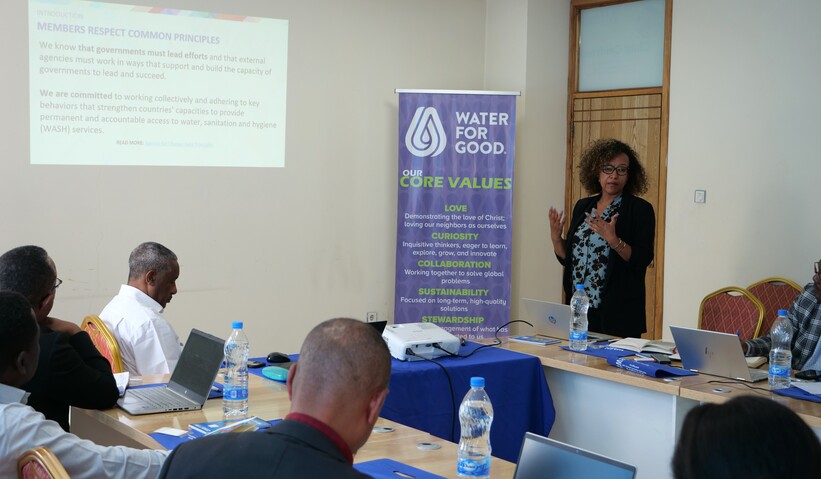
Bethelhem Mengistu, Global Coordinator of Agenda for Change, presenting the global overview of the collaboration Photo by Tsegaye Yeshiwas
The Agenda for Change country collaborators in Ethiopia conducted the first 2025 quarterly meeting and underscored the need for reinforcing the collaboration within the sector as well as among the collaboration members, facilitating internal learning exchange, and jointly advocating and fundraising for WASH systems strengthening.
Published on: 11/03/2025
On March 5, 2025, over ten organisations working on water, sanitation, and hygiene (WASH) in Ethiopia convened at Water for Good’s Headquarters in Addis Ababa with a shared goal. These organisations are committed to establishing a robust WASH system that delivers sustainable WASH services to all. They believe that constructing WASH infrastructure alone is not enough, but all-rounded WASH building blocks including post-construction management is essential to keep services running for everyone, for ever. As kindred spirits, they are united in their mission. This initiative is part of the Agenda for Change collaboration in Ethiopia, with IRC WASH Ethiopia serving as both a member and the current coordinator for the country collaboration.
This year’s first quarterly meeting in Ethiopia discussed the best approaches to improve the collaboration within the sector, as well as among its members, reinforcing internal learning exchange, and jointly advocating and fundraising for WASH systems strengthening.
The history of the country collaboration in Ethiopia
The establishment of Ethiopia’s country collaboration dates back to 2018, with the name “National WASH Systems Strengthening Initiative”, according to Lemessa Mekonta, Country Director of IRC WASH Ethiopia. The main objectives of these collaborations are learning and coordination on WASH systems strengthening through the area-wide approaches, and influencing through advocacy for adoption and scaling up of systems approaches. The country collaborators meet quarterly and discuss the systems strengthening efforts of each organisation, their synergy and the way forward.
Since its establishment, the collaborators have developed terms of reference, taken initiatives to increase membership , organised quarterly meetings, co-created and rolled out woreda-wide approach guidelines, hosted cross-regional learning exchange events, and used the WASH Systems Academy for capacity building (translated the WASH Systems Strengthening: The Basics course into two local languages and successfully launched them).
Currently, there are nine such country collaborations in the world, some of them being Ghana, India, Malawi, Rwanda, Uganda, Nepal, and Cambodia. Bethelhem Mengistu, the Global Coordinator of Agenda for Change, presented an overview of the collaboration efforts. According to her, Agenda for Change has 22 member organisations worldwide. The collaboration works to promote and support national and local governments to strengthen WASH systems for sustainable WASH services for everyone by 2030. The pathways to achieve the vision are training and capacity development, learning, leadership, access to finance, and attracting new members and associations. To build strong WASH systems, Agenda for Chang believes in the need to work on the building blocks such as institutional arrangements and coordination, finance, service delivery infrastructure, monitoring, planning, regulation and accountability, water resource management, and learning and adaptation.
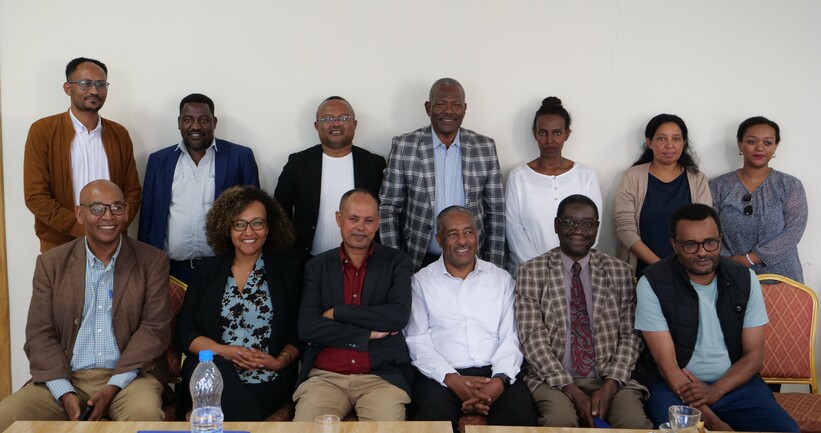
The country collaboration members shared their systems strengthening efforts in their focus districts. Their main engagements were on supporting districts in developing their own long-term WASH master plans, conducting building block scoring and analysis activities, improving water service delivery through professionalisation, setting up a WASH management information system, water resource management, capacity building training, private sector engagement and support, influencing, alignment with the Total Sanitation to End open Defecation and Urination (TSEDU) initiative, and climate resilience. The country collaboration members underscored the need for learning exchange amongst members and identifying learning themes for future meetings.
The key areas of the 2025 work plan were presented and discussed in the meeting. Conducting the national WASH building block analysis and scoring as continuation of the preceding years, replication and implementation of the area-wide approach guidelines developed by the country collaborators, joint event organisation and influencing, joint fundraising, and internal capacity building are all on the agenda for this year.
