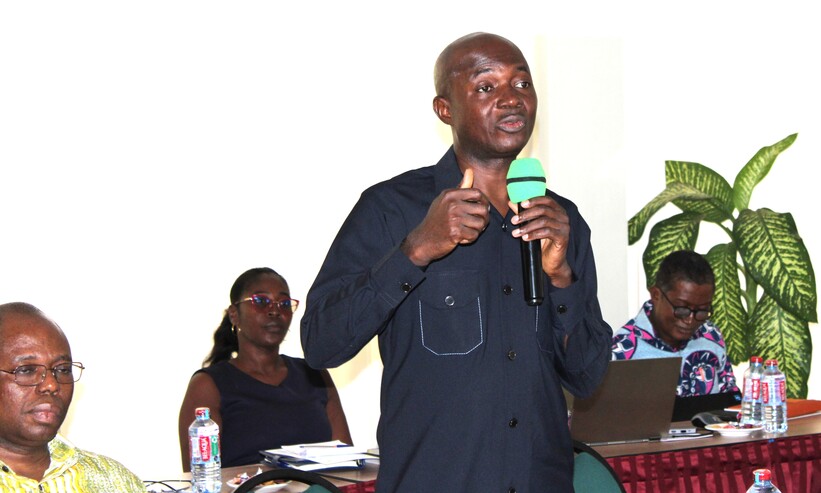
Participants at the event
State of water services in western region and dialogue on project progress
Published on: 12/04/2024
In Accra on 26th March 2024, IRC Ghana, in collaboration with the Rural Water 'Utilitisation' Project (R-WUP) partners, hosted over sixty-five stakeholders on the National Level Learning Alliance Platform (NLLAP).
The R-WUP is a three-year initiative co-conceptualised by the Community Water and Sanitation Agency (CWSA), Water and Sanitation for the Urban Poor (WSUP), IRC Ghana, and Safe Water Network (SWN). The project supports CWSA in establishing an effective rural and small-town water utility model in the Western Region, with strengthened capacity at the national level. It also aims to support CWSA in its internal change management processes, improve operational efficiency, develop infrastructure for safely managed water, and support sector strengthening and learning.
The main objective of the engagement was to share findings from the report on the State of Water Services in the Western Region, and to provide a platform for discussions on the progress of R-WUP implementation. It aimed to improve partnerships, coordination, and clarity on CWSA's approach to becoming a rural utility.
State of Water Services in Western Region:
The Ghana Statistical Service (GSS), together with IRC Ghana and partners conducted a mapping exercise covering 14 districts, revealing that 88% of people in the Western Region have access to safe water, with 77% having basic/limited access and 11% safely managed. The main delivery models identified were utilities, community management, small water enterprises, institutional management, private management, and other management types.
50% of the population is served by Limited Mechanised Schemes (LMS), 30% served by piped schemes, and 20% served by hand pumps. 17% of the LMSs were non-functional. 32% of piped schemes are non-functional. Over 90% of hand pumps and hand-dug wells are managed by communities. However, there are 57 hand pumps that are not managed by anyone, imposing serious consequences on the sustainability of these hand pumps.
sixtus_of_gss_and_veronica_of_irc_ghana_responding_to_questions_at_the_event.jpg
 Sixtus of GSS and Veronica of IRC Ghana responding to questions at the event
Progress of implementation:
Construction of Water Infrastructure: CWSA Western Region, highlighted progress in two communities. At Wassa Dunkwa, feasibility studies, hydrogeological prospecting, and borehole drilling are complete, with civil works 95% complete. At Mpohor, feasibility studies and hydrogeological prospecting are complete, but borehole drilling was unsuccessful. At Adum Banso, borehole sitting is completed and borehole drilling is ongoing.
Internal Organisational Change Management: WSUP presented the Utility Strengthening Framework, focusing on staff self-assessment and ownership of the change process. Successes included staff engagement training, leadership training, and developing a staff development roadmap.
Operational Efficiency of Water Systems: SWN and WSUP are improving CWSA's operational efficiency, addressing water safety, energy efficiency, and non-revenue water management. Training sessions covered water quality, water safety planning, and improvements to the Esiama Water System. A billing software pilot was also implemented.
img_5608_tony_of_wsup_at_the_event2.jpg
 Anthony of WSUP presenting at the event
Participants' Contributions
Participants raised questions and shared perspectives, including the impact of illegal mining on water bodies, policy backing for CWSA's transition, and how R-WUP information informs CWSA reforms. They suggested stopping the handover of water systems to untrained community leaders due to health and sustainability concerns.
The meeting highlighted significant progress in water services in the Western Region and ongoing efforts to improve infrastructure and operational efficiency. Contributions from participants underscored the importance of addressing illegal mining impacts, ensuring policy support for reforms, and improving water system management.
The collaborative efforts of CWSA, IRC Ghana, WSUP, SWN, and other partners are crucial in achieving safe and sustainable water services for all communities in the Western Region. The progress of R-WUP implementation is on track, with construction works scheduled for completion, providing safe water to needy communities.