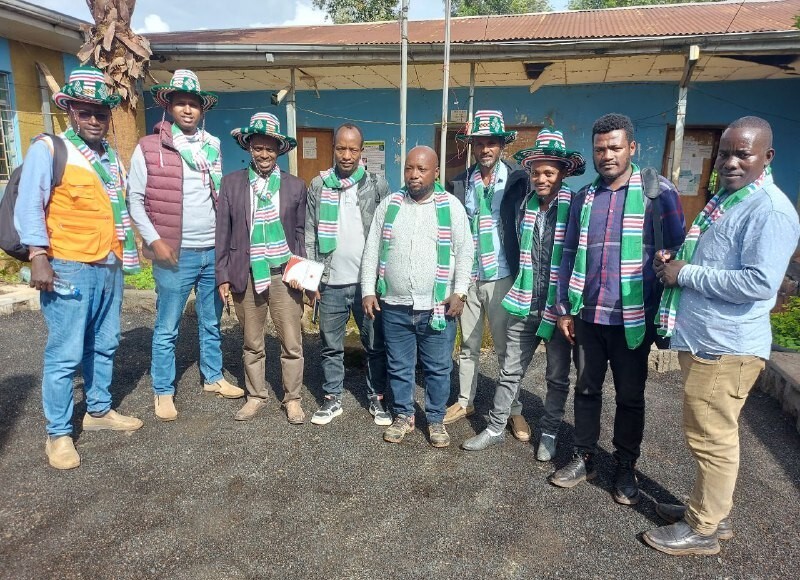
Representatives of partner organisations gathered at the woreda Administration Office
South Ari woreda has successfully implemented a multi-stakeholder approach, engaging NGOs, government bodies, and international partners like IPADA and the Allegro Foundation to secure both financial and technical support for water scheme maintenance.
Published on: 19/03/2025
South Ari woreda has a clear vision for its water, sanitation, and hygiene (WASH) future. It has a long-term master plan that meticulously identified its WASH gaps and developed a costed plan to achieve at least basic services for everyone by 2030.
It has been a few years since the woreda developed the WASH master plan and started implementing it. Despite progress in the woreda’s WASH services, the sector still needs strong efforts and collaboration to achieve its vision. As resources are the main challenge, the woreda, with technical support from IRC, developed a resource mobilisation strategy. The strategy focuses on raising funds from non governmental organisations working in the woreda, through influential people, and the community.
The woreda has a large number of spring-on-spot water sources, many of which are non-functional due to natural factors and poor management. Currently, 31 springs across 17 rural kebeles remain out of service, contributing to the woreda’s rising non-functionality rate and prolonged scheme downtime. Despite efforts to raise funds from the community, the required budget exceeds the financial capacity of local users, necessitating external support. In response, the Woreda Water Office is actively mobilising resources to strengthen water scheme maintenance as part of its WASH SDG master plan, developed with technical support from IRC. By collaborating with stakeholders, the office has adopted a data-driven approach to resource mobilisation. This enables evidence-based advocacy for sustainable water services in partnership with signatories of the WASH master plan implementation Memorandum of Understanding (MoU), WASH partners and other potential funders.
The Water Office took the initiative to reach out to influential people, advocating for solutions to WASH challenges and mobilising resources. The Woreda Administration played a significant role in coordinating MoU signatories. Building on this, Professor Gebre Yintiso, a member of Inclusive Peace and Development for Africa (IPADA) and a resident of the woreda, used his global network to facilitate partnerships. This effort brought in the Allegro Foundation from Spain. Primarily focused on health, this Foundation acknowledged the direct link between access to clean water and public health, extending its support to tackle water-related challenges. Through this integrated approach, both local advocacy and international collaboration have strengthened efforts to improve WASH services in the woreda.
The Woreda Water Office led a team of different stakeholders and conducted an assessment to identify non-functional water schemes. The team conducted a comprehensive assessment in 17 rural kebeles, gathering insights from community members and scheme managers, and found that 31 out of 96 spring-on-spot water schemes were non-functional. This forced the community to use unprotected water sources and creating significant health risks. Additionally, the findings showed critical water shortages in high-risk communities.
In their initial assessment, the team identified a need for 791,080 ETB in materials and 503,000 ETB for labour and supervision. It also highlighted the urgent necessity to strengthen local water management systems.
A stakeholder meeting on July 1, 2024, brought together representatives from World Vision, Action for Development (AFD), IRC WASH, Red Cross Jinka, the Woreda Administration, Allegro Foundation, and IPADA. The discussions led to concrete commitments:
This collaborative effort marks a significant step towards sustainable water scheme management in South Ari woreda. By aligning efforts across government, NGOs, and private actors, stakeholders are not just addressing immediate maintenance needs but laying the foundation for a resilient, community-led water governance system. Continued engagement will be key to achieving the woreda’s WASH SDG plan targets and ensure lasting impact for future generations.
Following the discussion, World Vision has supplied industrial materials to the value of 2.5 million ETB, sufficient for the maintenance of 18 spring water sources. Meanwhile, the Red Cross Jinka office is actively collecting funds for the rehabilitation of five selected water schemes, which are still works in progress. Additionally, the Allegro Foundation and IPADA have jointly contributed 360,000 ETB to cover the wages of masons, as well as technical support for the sites for which World Vision has supplied materials. In additions to these efforts, the South Ari woreda administration has procured additional industrial and construction materials, while also facilitating community contributions and providing logistical support to the Woreda Water Office.
"The required budget is small and can only be covered by either IPADA or the Allegro Foundation. However, it is crucial to foster collaboration among various actors in the woreda. To facilitate this, we are strategically limiting our contributions to encourage broader engagement from others." – Professor Gebre Yintiso
Professor Gebre and the Woreda Chief Administrator are closely following up on progress through a Telegram group established for this purpose.
South Ari woreda has successfully implemented a multi-stakeholder approach, engaging NGOs, government bodies, and international partners like IPADA and the Allegro Foundation to secure both financial and technical support for water scheme maintenance. Rather than depending on a single funder (projects), stakeholders have pulled together and have strategically limited their individual contributions to encourage wider participation and shared responsibility. The Woreda WASH SDG master plan has further strengthened this collaborative model.