Global financing for water, sanitation, and hygiene (WASH) remains insufficient, hindering progress towards universal access.
Published on: 07/04/2025
This blog was co-authored by Ruchika Shiva and Digbijoy Dey
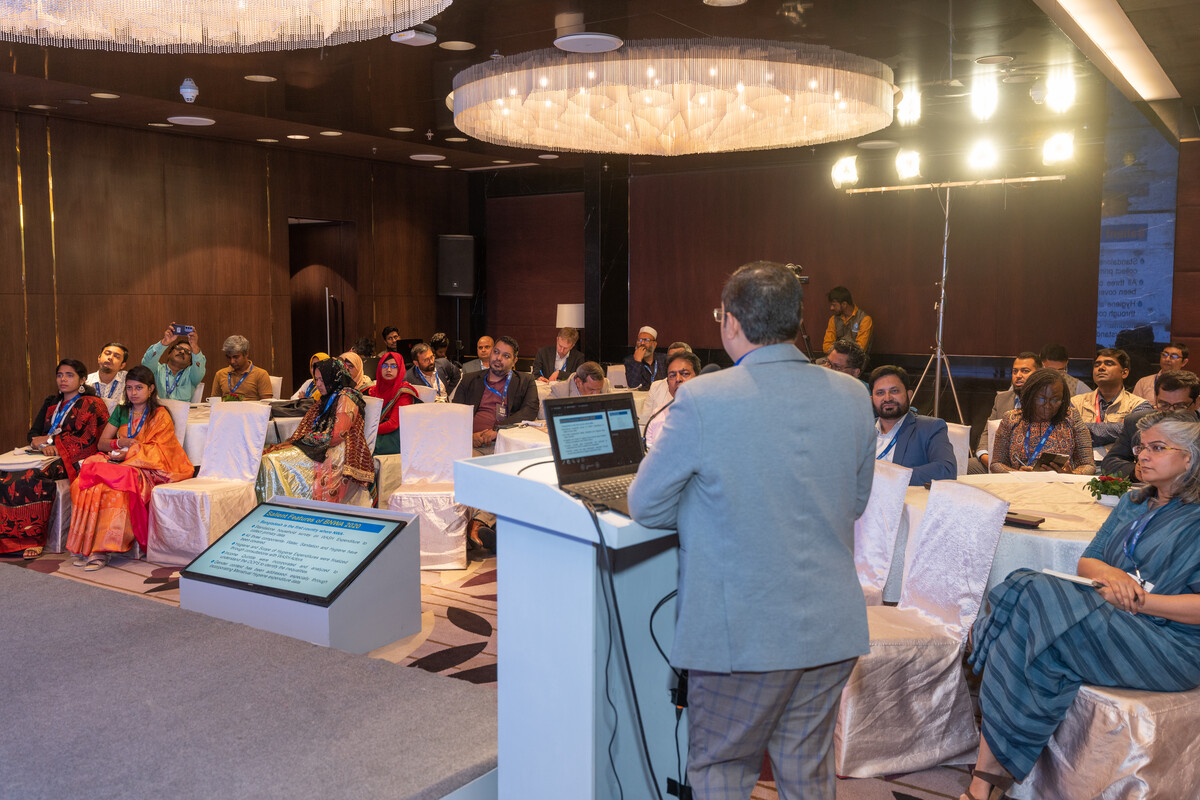
According to GLAAS 2022, 75% of countries report inadequate financial resources to implement national WASH plans, with only 45% on track to achieve drinking-water coverage targets and a mere 25% on track for sanitation targets. In low- and middle-income countries, the cost of subsidies associated with the operations, maintenance, major repair and replacement of existing WASH infrastructure is estimated between 1.59% and 1.95% of the gross domestic product (GDP). Bangladesh is no exception. The recently held Toilet Conference in Dhaka, Bangladesh, has brought the issue of the gap in WASH finance to the forefront, highlighted both the macro and micro aspects of the finance gap and possible sources of alternative finance. This blog tries to bring together the discussion points from the different WASH finance sessions at the conference.
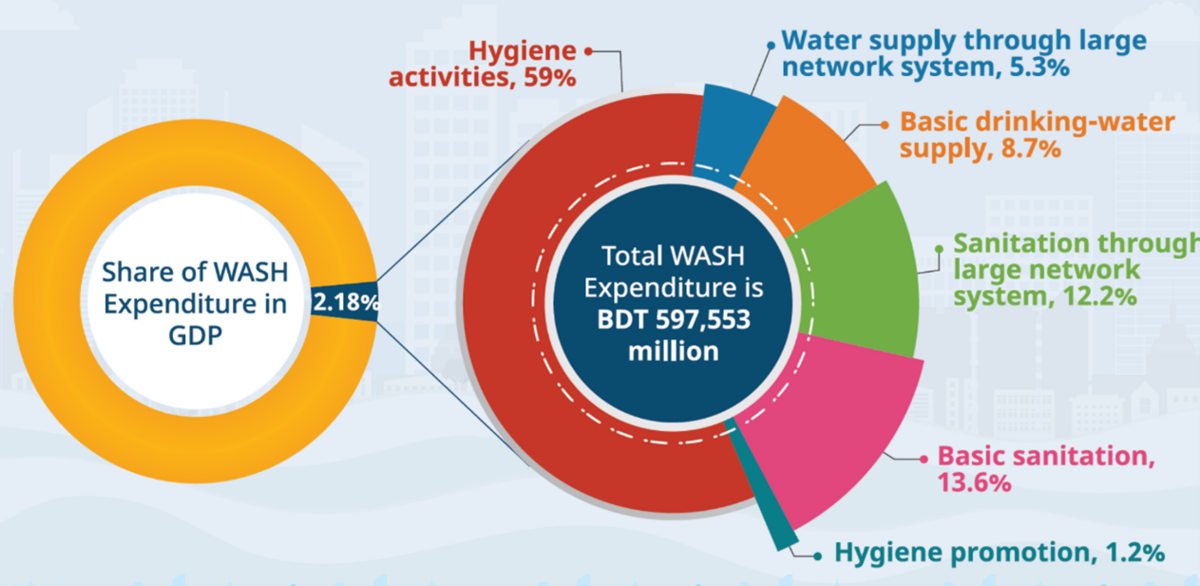
WASH enthusiasts know that every dollar invested in water and sanitation brings a four-fold return. But the statement is not sexy enough to bring in investments for WASH. At the conference, IRC and WaterAid organised a technical session, this session covered the macro aspects of WASH finance based on the findings from the Bangladesh National WASH Accounts 2020 which were published in 2022. We could see that WASH sector expenditure was BDT 598 billion (approx. USD 6 billion) which is 2.18% of the country's GDP. Households spent an average of BDT 11,574 annually on WASH. This represented 4.3% of citizens' average annual household income. WHO and UN-Habitat used a range of 3-5% of household income as an affordability threshold for drinking water and sanitation services. While it is 4.3% on average in Bangladesh, the poorest quantile of the population spends three times more than the richest quantile according to the WASH Accounts 2020 (the richest are spending 2.8% while the poorest are spending 7.8% of their yearly income on WASH services).
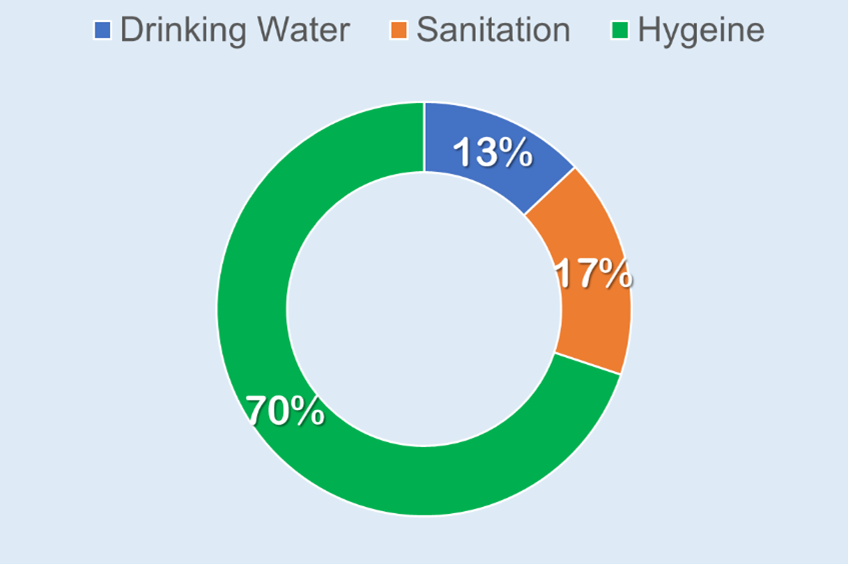
Eighty-one percent of the expenditure comes from households (self-supply), 16% of the expenditure comes from central and sub-national government funding and the rest comes from tariffs, repayable finance, grants and other sources. While a major portion of the household expenditure on WASH goes to hygiene (70%), the expenditure on drinking water and sanitation is less, 13% and 17% respectively. The central and sub-national government expenditure (16%) was less than USD 1 billion.
According to the 2017 SDG Financing Strategy of the General Economic Division, Bangladesh requires an additional USD 9.34 billion on top of the usual investment to achieve SDG 6.1 and SDG 6.2. The Bangladesh government has allocated about USD 563 million in the fiscal year 2017-18 and USD 641 million in 2018-19 of its Annual Development Budget (GLAAS 2018/2019). While there is a clear rise in public sector investment in the year 2020 compared to previous years, the question is whether it is enough. Contrary to the assumption of the sector, the National WASH Accounts showed that the finance coming from public, private and development assistance is lower than estimated. It was not 50% from public finance, 30% from the private sector and 20% from development assistance as previously assumed.
While public investment and development aid are insufficient to cover the gap, other sources are stepping up to meet the need. Microfinance Institutes (MFI) are gradually adopting microfinance products for water and sanitation services. We know from the analysis of and experience on repayable finance for WASH from BRAC, that while microfinance has great potential, it has certain drawbacks. There is a risk of the loan being used for other purposes, which is known as ‘fungibility of loans'. Among the households who construct water or sanitation infrastructure using microcredits, some are only interested in basic infrastructure, not safe infrastructure. While efforts to build the capacity of small WASH entrepreneurs who provide services to self-supplied households are in place. There are efforts to de-risk the investments of these small WASH entrepreneurs as well.
The WASH Accounts 2020 has given us a good insight into the WASH funding gap in the country. It is time to revisit the costs of the gap to reach SDG 6.1 and SDG 6.2, as well as the funding sources. It is important to get the key sectors (WASH and Finance) to understand:
At IRC we have strong opinions and we value honest and frank discussion, so you won't be surprised to hear that not all the opinions on this site represent our official policy.