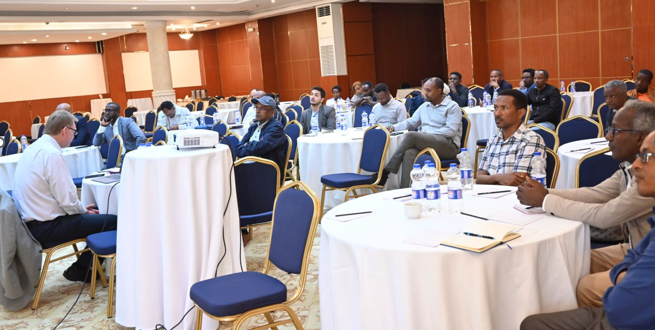
Participants attending the presentation of the research findings
The assessment focused on generating empirical insights into how rural utilities in three regions of Ethiopia (Amhara, Tigray and Oromia) operate, identifying key performance enablers and constraints, and proposing practical pathways towards professionalised service delivery.
Published on: 20/02/2026
A national validation and training workshop on the professionalisation of rural water service delivery was held from February 10 –12, 2026, in Addis Ababa, bringing together key stakeholders from across Ethiopia’s water sector to review research findings and strengthen collaboration for system reform.
The workshop was officially opened by Abera Endeshaw, Senior Advisor to the Minister of the Ministry of Water and Energy. In his remarks, he underscored the importance of piloting the study’s recommendations to test their practicality and scalability, emphasising that evidence-based reforms must be translated into actionable and context-sensitive implementation models.
Despite progress in expanding access to basic water supply in Ethiopia, rural water services continue to face structural and operational challenges. These include high levels of non-functionality, weak governance and accountability mechanisms, limited repair and maintenance capacity, low tariff collection efficiency, fragmented regulatory oversight, and inadequate sectoral coordination. To respond to these challenges, IRC WASH, in partnership with Millennium Water Alliance (MWA), conducted a comprehensive assessment of the professionalisation of rural water services. The assessment focused on generating empirical insights into how rural utilities in three regions of Ethiopia (Amhara, Tigray and Oromia) operate, identifying key performance enablers and constraints, and proposing practical pathways towards professionalised service delivery.
Key recommendations of the assessment include:
Participants included representatives from national government institutions, Regional Water and Energy Bureaus from Amhara, Oromia, and Tigray, as well as Zonal and Woreda Water and Energy Offices from the Amhara Region, alongside NGOs and development partners active in the sector.
An important outcome of the workshop was the exchange of practical lessons across regions. The cross-regional dialogue facilitated by the assessment demonstrated that the transition towards professionalised water service provision can be accelerated through peer learning, adaptive management, and deliberate replication of proven models.
Participants from Amhara and Tigray reflected that the study helped them learn from the experience in Oromia, where the merger of urban utilities with neighbouring rural water supply systems has contributed to improved service delivery. By consolidating management structures, technical expertise, and financial administration under a single utility model, these merged entities have demonstrated stronger operational coordination, improved cost recovery, and more consistent service standards. The model suggests that scale and institutional integration can enhance both technical performance and governance coherence.
On the other hand, participants from Oromia emphasised the importance of technological innovation in addressing operational constraints. Two examples were particularly noted:
The initiative is part of the Strategic Transition Program (STraP), funded by Hilton, and implemented by MWA. STraP aims to contribute to systemic improvements in rural water service delivery by strengthening policy, regulatory, financial, and operational foundations. By advancing evidence-based reforms and capacity development, the programme is laying the groundwork for sustainable, accountable, and resilient rural water services in Ethiopia.