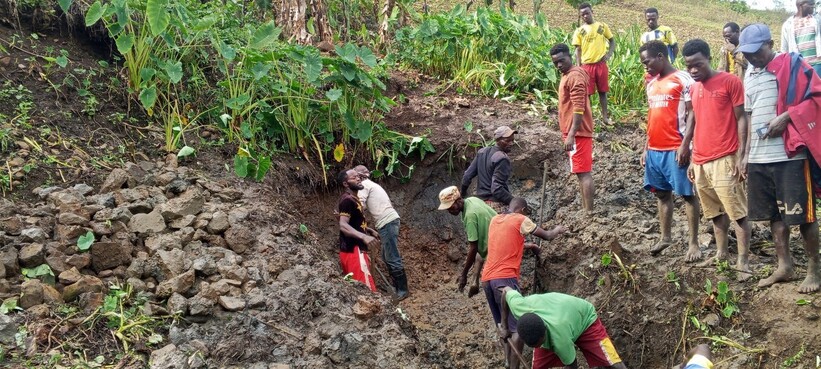
Community participation during the construction of Zulbod spring at Shenkamer village Photo by Nebiyu Gashawbeza
This is the story of the people of Shishir Kebele in South Ari, a story that showcases the power of community in securing basic water services.
Published on: 25/06/2025
South Ari Woreda, the most populous and geographically wide in Ari Zone, has the highest number of water schemes and relatively good water coverage. However, the woreda asset management data shows 32% of the population has access to basic water services.
The woreda launched a 10-year plan to achieve improved water supply, sanitation and hygiene (WASH) coverage as per the SDG standards. It is halfway through implementation, supported by a resource mobilisation strategy.
Among 28 kebeles in South Ari Woreda, Shishir is recognised for its valuable experiences, which serve as a model for learning and replication by other kebeles in the Woreda, with a population of 6,204 living in 1,241 households. Currently, the kebele has a total of 17 water schemes, of which nine are functional, three are partially functional, one is non-functional, and four are abandoned. There are also three unprotected on-spot springs planned for future construction. According to the monitoring data included in the revised South Ari Woreda WASH SDG master plan, at the end of 2023, only 19% of the kebele population had access to basic water services.
In January 2025, the Woreda Water, Mines and Energy Office, in collaboration with IRC WASH, organised a training for the Shishir kebele’s Water Safety Planning (WSP) team on better implementing their water safety plan. Following the training, the WSP team updated the detailed WSP. According to the updated WSP, the kebele aims to reach three unserved villages by constructing three new on-spot springs and rehabilitating three non-functional on-spot springs. The strategy to implement the WSP involves mobilising resources from the user community, facilitated by the Woreda WSP team.
As a result of strong community mobilisation by the kebele team, three villages, Shenkamer, Bazgir and Wachamer have constructed their own on-spot springs and three other villages, Agintamer, Zagir and Wachamer have gained access to improved water sources through rehabilitation of the existing water schemes. Now, the number of villages with functional water schemes has increased to nine out of a total of 16 villages in the kebele. The three newly constructed water schemes serve 902 people living in 172 households, and the kebele basic water service coverage amounts to 47.5%. In April, a baseline water quality test was conducted for the three newly constructed on-spot springs.
Shishir Kebele took the following key steps that led to its success:
Genzilops on-spot spring
Genzilops on-spot spring is located in Bazgir village, where 216 people live in 50 households. The residents had been using water from an unprotected spring, after the previously protected on-spot spring water source was demolished during road construction in 2020. The other water source did not provide water because of a breakdown of the pump and generator. Therefore, following the discussions and awareness creation campaigns by the WSP team, the community agreed to contribute the maximum of their ability to build their own protected water sources. With the help of the village leader, 21,600 birr was collected in cash, and stones valued at an estimated 10,000 birr as an in-kind contribution. In addition, the community supplied food for the local artisan for seven days.
Weisho Mamo from Bazgir village said, “We were using unprotected spring water with a risk of contamination, and people have been getting sick, especially children. Now, we are drinking confidently because the water is safe and clean. Therefore, we all monitor the water’s safety, as we built it together, so we all protect it equally. Previously, we were fetching water from the ground, but now, clean water flows directly to our jerrycans.”
Zulbod on-spot spring
The second scheme is Zulbod on-spot spring. It is found in Shenkamer village, where 197 people live in 42 households. Going through the same process, the village collected 25,600 birr in cash and in-kind contributions were estimated at 11,500 birr. In addition, the community supported with labour and supplied food for the artisans until the construction was completed.
Gezahegn Kermi, village leader of Shenkamer, said: “At first, each household contributed 100 birr, it wasn’t enough, then the community discussed and agreed to contribute an additional 150 birr per household. The construction took 15 days to complete. The Kebele Federation contributed 3 bags of cement. We continued collecting post-construction monthly fees and saved 2,000 birr in a micro-savings account. The community promised to actively protect the water source and ensure sustainability.”
Barenda on-spot spring
The third scheme isBarenda on-spot springfound in Wachamer village, which is the most populated village in the kebele, with 492 people living in 80 households. The residents had been using water from an unprotected source after the previous on-spot spring and handpump failed, having stopped functioning after 20 years of service. As a result, people were forced to use an unprotected spring near the village. The South Ari Woreda Water, Mines, and Energy office had a plan to rehabilitate these non-functional schemes using the woreda budget. But after discussions with the community and consultation with the woreda water engineer, the community agreed to take on the rehabilitation of the schemes in the next plan, while the woreda would use this budget to construct a new on-spot spring. A total of 35,000 birr was contributed by the woreda government and 24,000 birr by the community in cash and in-kind contributions to complete the construction.
Ezra Agidew, one of the users of the Barenda on-spot spring, says: “The old water source couldn’t meet our demand due to population growth. People, including children, were missing school, waiting in line from 6 AM to 10AM just to fetch water. Now, both adults and children fetch water quickly without long waits, and children no longer miss school because of water collection. The community remains ready to contribute further if more work is needed to maintain or expand the system.”
shenkamer.jpg
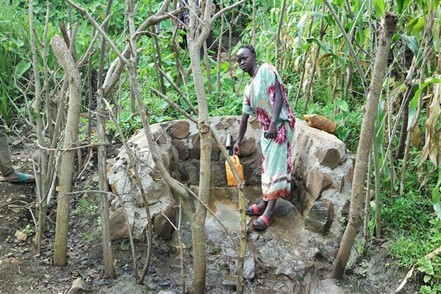 Zulbod on-spot spring after construction in Shenkamer village Photo by Nbiyu Gashawbeza
From all these steps, we learned that community ownership drives success. When communities participate in co-designing and funding projects, they ensure long-term sustainability.
Awareness creation is critical to mobilise communities. Providing training on water safety and hygiene for community leaders and conducting discussions with the community can contribute to changing behaviours.
Leveraging local resources is a powerful approach. It could be in cash and in-kind contributions (cash, stones, and labour), which reduces dependency on external funding.
It is important to prioritise equity. Wherever we plan to improve WASH services, targeting unserved villages first ensures no one is left behind.
Combining awareness creation, collective financing, and low-cost solutions can be a replicable blueprint for improving rural WASH services.