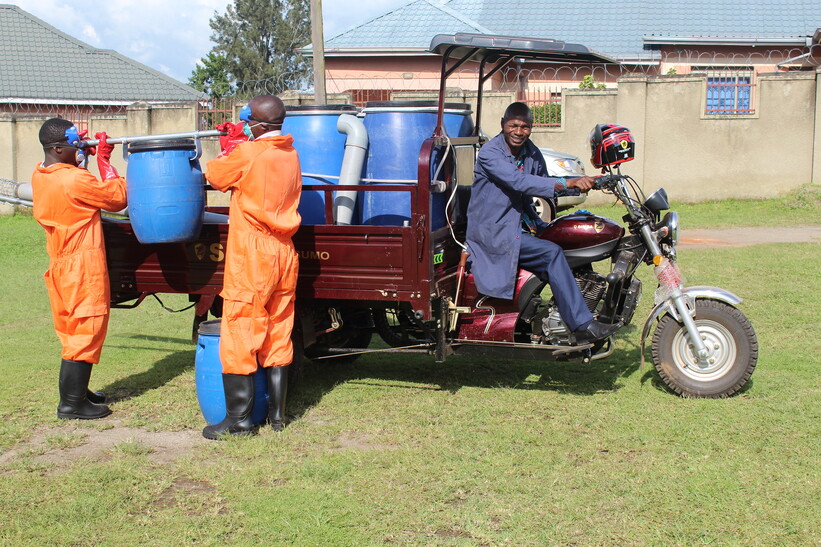
Sanitation pit emptying by KAHASA in Uganda
For our last Finance Connect session before the summer, we turned to a question that features in every conversation about WASH finance: how do you actually move money so that it reaches the people who need water and sanitation — and keeps reaching them after the donor changes priorities?
Published on: 08/07/2026
The Finance Connect sessions are hosted the same way each time. Someone asks about a topic, I gather a handful of people from around the world who are genuinely doing something about it, and we have an honest conversation.
This time we had two very different cases on the table: a blended finance facility for private water operators in Cambodia, and a results-based approach to public sanitation spending in Uganda. Both, it turned out, were arguing the same point — that the cost of money (the interest rate) is rarely the thing standing in the way.
Michele Paba, Chief of WASH, Climate and Environment at UNICEF Cambodia, opened with the WISE programme — Water Infrastructure and Smart Energy. It's a joint programme run by UNICEF and UNCDF under the government's lead ministry, funded by the Joint SDG Fund, that started this year.
Cambodia has made real progress on rural water, but reaching SDG 6 will need somewhere in the order of US$100–150 million a year. Much of the water services are delivered by private water operators — around 400 licensed Small and Medium Enterprises, often family-run businesses, serving some 3.5 million people. The problem is their access to finance. In-country lending comes with high interest rates, short loan tenors and collateral requirements that are simply out of reach for many of them. On the other hand, the banks are interested in the water sector, or at least in funding SMEs, but struggle with liquidity and barely use the credit guarantee tools available to them.
WISE tries to work on both ends at once: UNCDF brings concessional capital to selected financial institutions to lower their cost of capital and make loans more affordable. UNICEF builds the enabling environment and — this is the part I found most interesting — does the unglamorous work of creating a pipeline: screening operators, assessing their technical and financial needs, supporting climate-risk and feasibility work, and turning these operators into bankable borrowers. There are two channels by design: loans through the facility itself, and a second route using matching resources that UNICEF leverages from partners and impact investors. As a result, the facility might bring an operator's interest rate down from 9–10% to 6–7%, but for others you may need to go to 3–4%, and some are better served outside the facility altogether.
The headline KPI is one to eight: every dollar of initial investment is meant to unlock eight more, with US$16–20 million of commercial and concessional capital leveraged over 36 months. The first 18 months aim to bring 30 operators to investment readiness; by 2030, the hope is around 200,000 people with climate-resilient water services. And the long-term play is to fold the whole thing into Cambodia's Clean Water Development Fund, so it outlives the programme.
Diana Keesiga of Water For People took us somewhere quite different — results-based financing for sanitation, channelled through the Sanitation and Hygiene Fund. Her starting point was blunt: across a decade, the data that tracks progress in the sector (JMP) shows barely a 3% incremental improvement in basic and safely managed rural sanitation over the past 10 years. Coverage is one problem; slippage is the deeper one — households build facilities that collapse within a year, or drift back to open defecation after a community has been declared open-defecation-free. Districts receive money from treasury for sanitation every year and report thin results.
So rather than funding activities, the programme pays for outcomes. The input grant is entirely the government's own money — the Primary Health Care grant from the Ministry of Health and the Sanitation and Hygiene grant from the Ministry of Water. Independent verification confirms what was actually achieved on the ground, and only verified results release additional funds. As Diana put it, the conversation shifts: you stop asking districts whether the money arrived, and start asking what they did with it.
The initial results are limited but telling. In the first 12 months across two pilot districts, 413 households built new or upgraded facilities; under US$10,000 in incentives leveraged over US$124,000 in household investment. Crucially, it made one rule work: the rule that 30% of the Primary Health Care grant should go to environmental health — a rule that had existed largely on paper until the incentive gave districts a reason to use it.
The model is now being implemented in four districts, and the team brought in an independent audit firm to verify results. Of roughly 500 results districts submitted, fewer than 300 passed — 37% didn't qualify.
Cambodia's facility is aiming for a 1:8 ratio of leverage; Uganda's sanitation model is already running closer to 1:15 in household investment per public dollar. What makes the Uganda case distinctive is that the government is the primary investor. This is blended finance in the truest sense: public district budgets meeting private capital from households.
As an economist I was taught not to distort the market — interest rates reflect risk and the lender's costs, and subsidising them is a mistake.
Colleagues who had run microcredit programmes for water and sanitation argued they'd deliberately not subsidised the interest rate — the goal was to prove repayment was strong enough that lenders would mainstream WASH across their portfolios on their own. They'd shown what small water providers can and do to repay loans at market rates. The viability was not the issue, the problem was scale: most providers either can't afford market rates or won't take on the debt, and offering a longer ten-year tenor helps but often is still not enough.
Michele's experience in Cambodia also shows that the problem was not the cost of capital — it was that the bank kept fixating on the interest rate while undervaluing the pipeline of 30 bankable projects being handed to them, projects they'd never have generated on their own. Tenor, repayment modality, cash-flow realities — these matter as much as, and sometimes more than, the interest rate. An operator can fail to repay a cheap loan because the repayment schedule never matched their cash flow.
From Uganda, Diana’s reflection was that sanitation loans only really take off where sanitation is already understood as part of people's economic life — a busy trading centre, an up-and-coming market town. Elsewhere, the obstacle isn't the interest rate at all. It's that people still see sanitation as a social good they shouldn't have to borrow for.
When is subsidising the interest rate justified, and when is it just papering over a market that will never stand on its own? "It depends on who your market is and what you're trying to prove" was the fairest answer in the room.
We have now a few years of guarantees and revolving funds propping up microfinance institutions, and too often the moment the support is withdrawn, the cost of capital snaps back and the lending stops. So, what is the actual exit strategy?
In Cambodia, can merging into a government development fund sustain the on-lending and de-risking once the programme ends? In Uganda, Diana's bet is that the real durable asset is a changed culture — administrators who, having seen what their own budgets can do, keep demanding results even after the incentive is gone. Is changed behaviour the most underrated form of financial sustainability we have?
Next sessions: cost-benefit analysis & social returns (in September) and sanitation value chains (in November). I’m still looking for good examples, drop me a message if you have one.
--
About Finance Connect:
As part of an ongoing effort to deepen expertise and elevate the global conversation around WASH Finance, Water For People and IRC through the One For All Alliance have developed a series called Finance Connect. It brings together a range of perspectives and experiences and creates a space where WASH professionals present and discuss targeted topics to do with how water, sanitation, and hygiene work is funded. Each session produces a blog with insights from the discussion, which we hope can serve as a resource for the entire sector to learn and, ultimately, channel more resources and attention to the critical topic of universal and sustainable water, sanitation, and hygiene services for the billions of people whose needs are not currently being met.
At IRC we have strong opinions and we value honest and frank discussion, so you won't be surprised to hear that not all the opinions on this site represent our official policy.