A summary of the discussions and lessons from the 2025 Nigeria Learning Forum
Published on: 05/03/2026
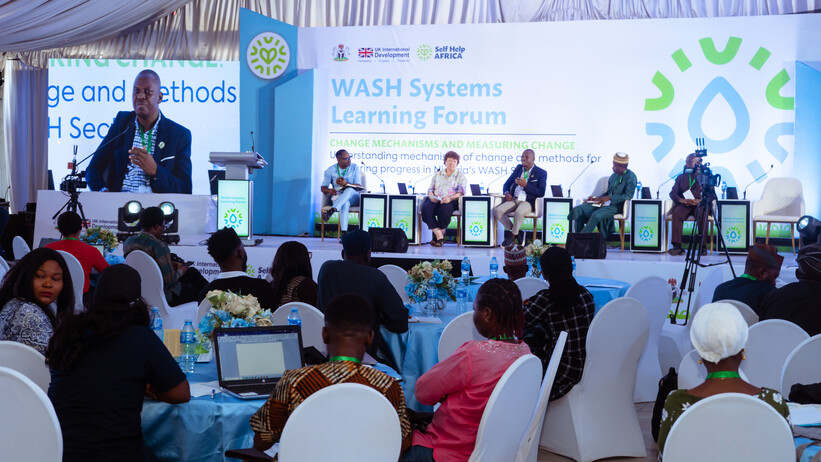
In late November 2025, Abuja became the meeting point for people who are quietly trying to change how water, sanitation and hygiene (WASH) work in Nigeria and Sierra Leone. The Nigeria Learning Forum, held under the WASH Systems for Health (WS4H) programme funded by the UK’s Foreign, Commonwealth & Development Office (FCDO), brought together government leaders, civil servants, civil society, development partners and practitioners around one big question: How do we move from scattered projects to strong systems, and how do we measure that change?
The theme “Change Mechanisms and Measuring Change” wasn’t chosen by accident. The Forum was intentionally scheduled right after Nigeria’s maiden National Sanitation Conference, so that the energy, honesty and uncomfortable truths from those spaces could flow directly into deeper reflection and joint problem-solving.
Opening the Forum, the representatives for FCDO and the British High Commission reminded participants that WS4H spans six countries–Nigeria, Sierra Leone, Malawi, Tanzania, Nepal and Bangladesh–with a core focus on driving system change so that WASH services are sustainable and equitable, particularly for women and girls.
In her remarks, Head of Human Development and Demography at the British High Commission, Jill Fletcher, underlined that WASH is not just about Sustainable Development Goal 6; it is foundational for health outcomes, gender equality, economic growth and national development agendas. She also stressed a partnership approach where partners “work together as equals” and challenged everyone to use the Forum to openly question assumptions and co-create solutions, not just exchange slide decks.
In her opening remarks, Joy Aderele, Country Director of Self Help Africa, highlighted the need for renewed commitment to strengthening WASH systems beyond individual project cycles. She stressed that sustainable change requires collaboration, accountability, and a willingness to rethink old ways of working. Her message set the tone for the conversations that followed: progress is possible, but only when the sector works as one.
From the Nigerian side, the keynote address which was delivered by Mr. Richard Pheelangwah, the Permanent Secretary of the Federal Ministry of Water Resources and Sanitation on behalf of the Honourable Minister, Engr. Prof. Joseph Terlumun Utsev, framed the Forum as a continuation of a shift already underway: moving from stand-alone, infrastructure-heavy projects towards system strengthening; and from short-term interventions towards policies, institutions, finance, data and accountability that keep services running for decades, not months.
The minister’s speech celebrated real progress:
But it also named the gaps bluntly:
Monitoring and accountability remain weak.
“Without systems that generate reliable data, guide decision-making and create accountability, even the best investments will fade,” the speech warned, comparing a WASH project without monitoring to cooking Jollof rice without tasting it until it’s too late.
Shadrack Guusu, Head of Programmes and WS4H Consortium Manager at Self Help Africa, set out how the WASH Systems for Health programme is trying to address these systemic bottlenecks in Nigeria and Sierra Leone.
In Nigeria, the programme works through a broad partnership including Society for Water and Sanitation (NEWSAN), Toilet Pride, BudgIT, Population Services International, Sanitation Learning Hub, Social Finance and the University of Bristol. Together they are focusing on four core result areas: strengthening sector planning and governance, sustainable rural water supply, accelerating rural sanitation, and strengthening sector capacity and networks. In his remarks, he highlighted some of the key achievements of the programme, such as policy reviews in Kano and Cross River states, stronger coordination platforms, preventive maintenance models for rural water schemes, and improved market-based sanitation efforts. A consistent focus across both countries is ensuring that women and girls remain central in WASH planning and service delivery.
In Sierra Leone, the WASH Systems for Health programme is led by GOAL Sierra Leone with partners like WASHNET and BudgIt, and it is focusing on three systems building blocks: Urban sanitation and solid waste management, WASH in health care facilities, and sector governance at national and district levels.
On behalf of the WASH Systems Facility a consortium of IRC, the University of Leeds and the London School of Hygiene & Tropical Medicine, Afou Chantal Bengaly emphasised that this Forum is more than an annual meeting; it is a platform for challenging assumptions, sharing realities, and co-creating solutions that strengthen monitoring, evaluation, learning, and coordination across the WASH ecosystem.
The day progressed into discussions on how system strengthening approaches can replace fragmented interventions, with a framing presentation made by Dr. Lauren D’Mello-Guyett of the London School of Hygiene & Tropical Medicine.
This was followed by a fireside chat with Engr. Suleiman Adamu reflecting on the role of political leadership and technical expertise in driving sector transformation, alongside case studies from Toilet Pride Nigeria and WASHNET Sierra Leone.
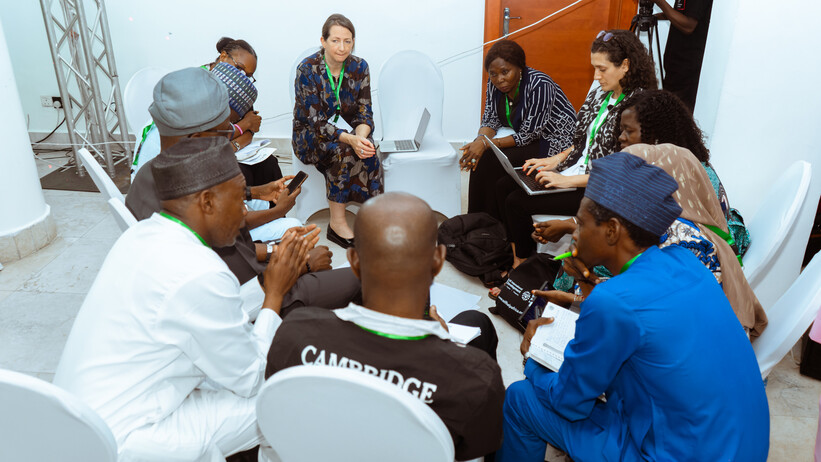
Across plenary discussions and breakout sessions, participants repeatedly returned to the same question: how do we build monitoring systems that enable action, accountability and sustained change across the WASH sector? In response, attention turned towards decentralising Monitoring, Evaluation, Accountability and Learning processes to monitor systems change and strengthening the cycle of WASH planning through efficient monitoring, evaluation and learning processes at the subnational level.
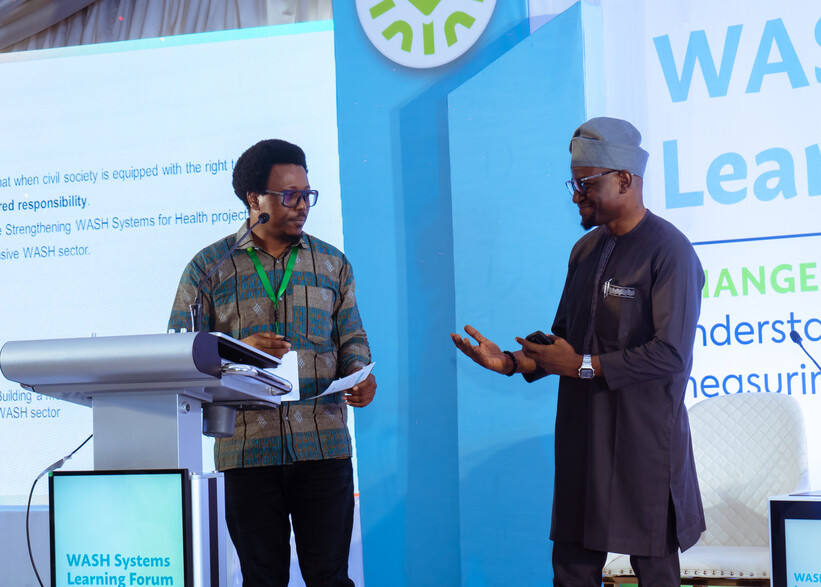
For starters, Aisha Suleiman, Monitoring, Evaluation, Accountability and Learning Manager at Self Help Africa Nigeria delivered a presentation that highlighted what a true and fully decentralised Monitoring. Evaluation, Accountability and Learning system should look like in practice. With this system,
However, this kind of system can only be achieved when local government areas and subnational actors are empowered as decision makers, and not simply data collectors for national dashboards. Contributions from the room pushed back against the reflex to generate even more indicators, calling instead for a deeper analysis of existing data to identify service gaps, slippage risks, and value-for-money failures. Similarly, discussions on planning underscored the need for evidence to directly inform investment decisions and coordination across institutions.
A few concrete priorities emerged across the board.
It was established overall that poor quality data as well as the perceived risk of producing ‘fantasy data’ in low-capacity settings could be even more harmful than no data at all.
The keynote from the Federal Ministry of Water Resources and Sanitation reminded everyone why rural water still matters so much:
From that diagnosis, the speaker walked through a set of levers of change that must be pulled together if rural systems are to last:
Community ownership and local governance
Strong policies, laws and institutions
Innovative and blended financing
Appropriate technology and local skills
Data and continuous monitoring
Political commitment
The panel that followed with voices from SURWASH, UNICEF, Self Help Africa and others brought these levers to life. Some of the most resonant points included:
By the end of the two days in Abuja, one message was clear: systems change doesn’t happen by accident. It is engineered, through deliberate design, disciplined monitoring, political courage and relentless learning.
The real success of the Nigeria Learning Forum will not be measured by how inspiring the speeches felt in the room, but by what happens next:
As one speaker reminded participants, a system is only as strong as its weakest link. In WASH, that weakest link might be data, finance, behaviour change, or institutional capacity, but whatever it is, it affects everyone.
The Nigeria Learning Forum did not claim to have all the answers. What it offered was something more powerful: a shared space where government, civil society, communities and partners could think together, deliberate constructively, and commit to concrete next steps for stronger WASH systems in Nigeria, Sierra Leone and beyond.
And that, in itself, is one of the most important “change mechanisms” we have.
Blogpost written by Afou Chantal Bengaly-IRC and Theola Amiokhaibhor- SHA Nigeria
At IRC we have strong opinions and we value honest and frank discussion, so you won't be surprised to hear that not all the opinions on this site represent our official policy.