The thematic overview paper Regulating Water and Sanitation Services explores the basics of regulation and this blog introduces the paper's key insights.
Published on: 21/01/2026
Access to safe water and sanitation is widely recognised as a human right. Yet for millions of people, especially in low- and middle-income countries, services remain unreliable, unaffordable, or unsafe. While infrastructure gaps and financing constraints are often highlighted, regulation—or the lack of it—plays a decisive role in shaping service outcomes.
The thematic overview paper Regulation Water and Sanitation Services explores the basics of regulation, how regulation influences water supply and sanitation services, what has worked in different contexts, and what remains challenging—particularly in fragmented and decentralised service environments.
This blog introduces the paper’s key insights and explains why regulation is gaining attention from policymakers, regulators, service providers, and development partners.
Regulation in the water and sanitation services is often associated with formal utilities, tariff-setting, and economic oversight. However, in many countries, especially in the Global South, services are delivered through a complex mix of public agencies, local governments, informal providers, and households. Sanitation services, in particular, extend far beyond sewer networks to include on-site systems, emptying services, transport, treatment, and reuse or disposal.
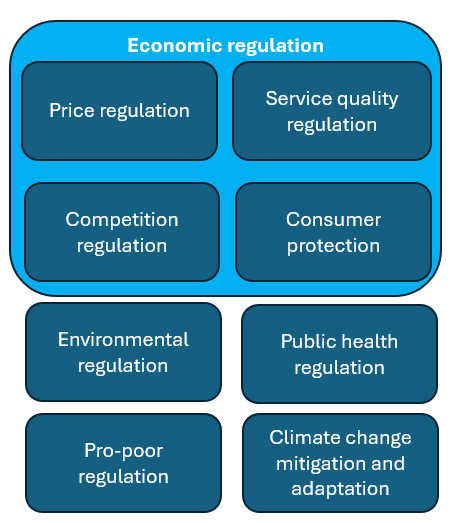
The paper argues that regulation must therefore be understood as a system component. This includes:
Without this broader regulatory ecosystem, investments in infrastructure and service delivery struggle to deliver sustainable and inclusive outcomes.
Despite its importance, regulation of water and sanitation services remains uneven and underdeveloped in many contexts. Common challenges include unclear institutional mandates, limited regulatory capacity, political sensitivity around tariffs and enforcement, and a historic neglect of sanitation—especially non-networked services.
Climate change further exposes these weaknesses. Flooding can overwhelm poorly regulated sanitation systems, contaminate water sources, and disrupt services. Water scarcity intensifies competition over limited resources, making decisions on allocation, service standards, and affordability more contentious.
Where regulatory systems are weak, these pressures are often managed reactively, rather than through planned, accountable, and preventive approaches.
Rather than promoting a one-size-fits-all model, the paper highlights principles that underpin effective regulation across diverse contexts:
The paper discusses the history, evolution and present water and sanitation service regulatory models of different countries. It shows that regulation does not always require independent national regulators. In some contexts, local government-led regulation, contractual regulation, or hybrid arrangements may be more feasible and effective.
Regulation is expected to act as a system steward, helping to guide sector development rather than simply enforcing compliance. As service delivery models diversify and responsibilities become more fragmented, regulation can provide coherence—aligning standards, incentives, and accountability across actors and levels, including for climate adaptation and resilience.
The paper underscores that strengthening regulation is not a technical fix, but a long-term governance process. Progress requires sustained investment in institutional, technical, and financial capacity; realistic and phased implementation of standards; and close integration with broader WASH systems strengthening efforts.
For governments and development partners, this means treating regulation as an essential component—critical to delivering safe, equitable, and resilient water and sanitation services.
Click on the title to download the paper.
The paper is co-authored by Digbijoy Dey and Marieke Adank
At IRC we have strong opinions and we value honest and frank discussion, so you won't be surprised to hear that not all the opinions on this site represent our official policy.