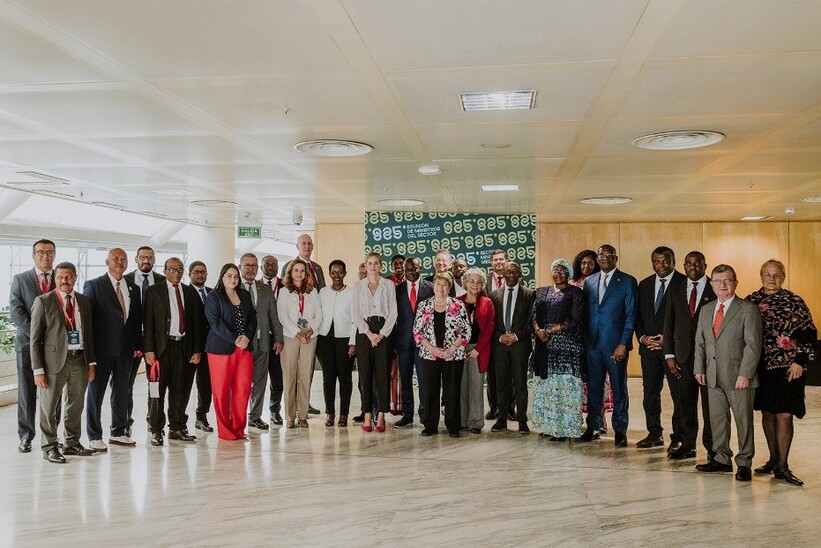
During SWA's recent Sector Ministers Meeting, the Uganda country team shared experiences on how climate risk assessments for WASH have shaped national water and sanitation resilience strategies.
Published on: 16/12/2025
As part of its high-level advocacy efforts, Sanitation and Water for All (SWA) organises alternate biennial Finance Ministers’ Meetings (FMM) and Sector Ministers Meetings (SMM) to build and sustain high-level advocacy for increased prioritisation and financing of WASH aimed at achieving universal access to WASH services. The latest SMM took place on 22-23 October 2025 in Madrid, Spain.
SWA in Uganda is coordinated by a SWA country team composed of representatives from government sector line ministries including the Ministry of Water and Environment, Ministry of Health, Ministry of Finance, Planning and Economic Development and Ministry of Education. The team has also representatives from the following civil society organisations (CSOs): UWASNET (CSO focal point), CIDI (CSO alternate), IRC, Water For People, WaterAid, AMREF Health Africa among others. External support agencies like UNICEF are also members of the country team.
The country team undertakes several activities including high-level advocacy and stakeholder engagement for WASH; evidence generation through studies and research; resource mobilisation through joint proposal writing; and also participates in planning and representation of the country in the FMM and SMM as well as other activities organised by the SWA secretariat, including reporting on the progress of country commitments at the FMMs and SMMs according to the Mutual Accountability Mechanism (MAM).
The Sanitation and Water for All (SWA) Sector Ministers’ Meeting (SMM) 2025 in Madrid was held under the theme: “Breaking silos: Uniting political leadership for integrating water, sanitation and climate action.” Ministers in charge of water, sanitation, environment and climate change from over 50 countries participated in the meeting.
The Ugandan delegation at the SMM 2025 constituted of five officials from government and civil society. These included Dr. Diana Atwine – Permanent Secretary, Ministry of Health; Dr. Alfred Okot Okidi – Permanent Secretary, Ministry of Water Environment; Dr. Herbert Nabaasa – Commissioner Environmental Health/ Government Focal Point for SWA; Martha Naigaga – Senior Environmental Health Officer/ Government Alternate Focal Point for SWA; Hellena Nakawooya Kasujja – Deputy Country Director, Community Integrated Development Initiative (CIDI)/ Civil Society Alternate Focal Point for SWA.
The SMM provided an opportunity to discuss evidence, insights, and partnerships required to holistically address water, sanitation and hygiene, incorporating water resource management and climate resilience, supported by sustainable financing needed to operate at scale to ensure that the human rights to water and sanitation are fulfilled.
Particularly, during the Ministerial Dialogues, Uganda shared experiences on how climate risk assessments for water, sanitation and hygiene (WASH) have shaped national water and sanitation resilience strategies, highlighting the processes, key challenges and innovative approaches to integrating WASH and climate. Uganda also provided insights into enabling climate-resilient water and sanitation services as well as integrated investment and efficiency for sustainable financing of WASH and climate action. We highlighted WASH as a priority adaptation sector as reflected in the Nationally Determined Contributions (NDC 2.0) with interventions and targets that align to the Uganda Vision 2040, NDP III and IV and Sectoral Development Plan. Our just concluded WASH National Adaptation Plan (WASH-NAP) in addition to the existing Health NAP (H - NAP) and the Agriculture NAP (Agri - NAP) will inform the ongoing Uganda NAP process and the NDC 3.0 that will define key adaptation and mitigation measures for climate response.
Other documents presented included the country overview that highlighted the country’s self-assessment and profile highlighting water resources and climate context, water supply and water quality, access to WASH services, institutional arrangements, key challenges, national priorities and opportunities.
Overall, the key outcomes of the SMM included the launch of the High-level Leaders Compact, renewed commitments under the Mutual Accountability Mechanism (MAM), and strengthened collaboration to accelerate progress toward SDG 6.
Uganda took stock of the achievements of the commitments made during the SMM of 2022 in Jakarta, Indonesia. A total of four commitments were made, and their status is highlighted below:
For the SMM 2025, Uganda made two new commitments, and these included:
Overall, the SMM was a good opportunity for high-level political leaders, technical officers and key stakeholder in the WASH sector to strengthen political will to prioritise water and sanitation in climate strategies; provide a framework for accountability that ensures that country commitments aren’t just symbolic but an opportunity to fast-track key actions; highlight the interconnectedness of the climate, health, economic crises and the central role of water and sanitation in resilience. The meeting reiterated the need for accelerated action toward SDG 6 by 2030.
In the absence of the Sector Ministers, the Permanent Secretaries of the Ministry of Water and Environment, and Health ably represented the country and demonstrated high-level ownership of country actions and renewed their commitment to SWA initiatives including the Heads of State Initiatives and the Presidential Compact on WASH.